Book Review: Sisters of the Vast Black

Title: Sisters of the Vast Black
Author: Lina Rather
Release Date: 29 Oct 2019
Source: bought 
Rating: 5 stars

I bought this book not long after it was released, sometime in late 2019, and then never got around to reading it, even though the premise was very exciting to me. Just one of those things, of course. But now I have finally taken the time to sit down and read it (it’s a novella, it only took about three hours once I finally just SAT DOWN), and wow was it great! (This also happens to be the first book of the year to fulfill a spot on my 2021 Reading Challenge!)

Sisters of the Vast Black is a novella by Lina Rather that manages to pack all the punch of a vast epic space opera into a very small 155-page package. It follows the space-faring convent of Sisters from the Order of Saint Rita, on board their living-ship called the Our Lady of Impossible Constellations. The sisters are out in the far reaches of space, in the “third system” of planets away from Earth, several decades after a disastrous and bloody war between Earth and its rebelling colonies. Most of the sisters have never even SEEN Earth, having been born and raised on space stations or other planets and moons. They administer to the sick and spread the word of God, though they feel that proselytizing is the least important of their duties. At the beginning of the story, they are going to a small moon to bless a brand new colony and perform marriage and baptisms for several colonists. But aboard the ship, many of the sisters harbor deep secrets.

The Mother Superior of their convent took a vow of silence forty years ago, and speaks using sign language, but is the REASON for her vow of silence that she has kept a closely-guarded secret for decades. Another sister is hiding the fact that she joined the convent under false pretenses. And a third sister has been keeping up a secret correspondence that could have a huge impact on her faith and her choices.

All of these things come to head in the climax of the story, when a distress signal calls them back to the colony they had just blessed weeks before. When they arrive, they must face many things: the consequences of their actions, the hypocrisies of the Catholic Church, and the renewed strength of the Earth Central Government.

To understand why I loved this little book so much, you’ll need a tiny bit of personal background info. I was raised in a very devout Catholic family until the age of thirteen, when my mother had an enormous crisis of faith and left the church. She became agnostic, and finally atheist, while I lingered in the faith for a very long time. Up until about the age of sixteen, I was pretty sure I was going to become a nun later in life. Even in college, by which point I had started to learn doubt and become angry with the hypocrisies of the Church, I still minored in theology. Nowadays, I don’t know what I would classify myself as, religiously-speaking: spiritual but not religious, uncertain and ambivalent and more than a little angry? But I still hold a deep fascination with and love for the saints, and my Patron Saint is, in fact, Saint Rita. 

Because of all this, Sisters of the Vast Black speaks to me on quite a few levels. First of all: I love a good space opera, and this is definitely a good space opera despite its small size. The science fiction elements are precise and well-written, and the ending was satisfying. But more importantly, the way the story deals with faith and doubt, with the contradictions of believing in God and messages of the Catholic faith while acknowledging and despising the evils of the Catholic Church, and with the inevitable blending between the Church and imperialist governments… all of this punched my right in the gut. All of the sisters were deeply sympathetic and complex characters that I could recognize and identify with myself or family and friends.

I do believe that anyone who enjoys a good space opera, or the compactness of a well-executed novella will like this book. But I think it will be ESPECIALLY potent for people who come from religious backgrounds in general, and the Catholic Church specifically. It will likely speak to you on a deep, perhaps even existential level. And if so, I hope you will share your thoughts with me sometime!

Book Review: The Order of the Pure Moon Reflected in Water

Book: The Order of the Pure Moon Reflected in Water
Author: Zen Cho
Release Date: 23 June 2020
Source: ARC borrowed from employer
Rating: 4 out of 5 stars

The novella The Order of the Pure Moon Reflected in Water by Zen Cho, published by Tor.com publishing, packs a surprisingly emotional punch in its little body. It has been marketed as wuxia-inspired, and it is definitely that (though there are far fewer martial arts fight scenes and flying about than one might expect if you are at all familiar with Chinese wuxia books or films). Instead this slim book is about inner battles and emotional landscapes.

In a vaguely Asian-inspired country under oppressive rule, Guet Imm, a former nun of the respected monastic order called The Order of the Pure Moon Reflected in Water, teams up with a group of bandits who are more than they appear. These bandits are not merely criminals, but political outcasts and rebels, trying to earn money for their cause. The bandits begrudgingly concede to their new companion (when Guet Imm gives them little choice), and accept her help in protecting a priceless religious relic.

Over the course of their journey through forests and mountains, the nun becomes a part of their found family, and inspires one bandit to reconsider the faith he had thought dead forever. And just to keep things interesting, they also have to fight for their lives.

This book is a wonderful meditation on what it means to choose your family and your path, deciding for yourself who and what is important no matter what society has to say on the subject.  It is also a beautiful examination of the joys, pains, and contradictions of religious faith – what means to have faith, to lose it, and to regain it. As a lapsed Catholic with a very complicated and ambivalent relationship to religion, I really appreciated and resonated with this facet of the story.

It is full of fun martial arts film tropes, and also features a gay man and a trans man – and neither of these identities is in anyway questioned or rebuked by any of the characters in the book, which is refreshing.

I gave this novella a 4 out of 5 because I genuinely enjoyed it and I look forward to what this author does next, but it didn’t totally WOW me. It didn’t knock my socks off. (And honestly, I would have enjoyed a bit more of that great wuxia staple: impossible flying-about martial arts fights.) Still, I would recommend it to anyone who enjoys a short fun novella, stories about found families, and/or people who like an Asian aesthetic in their fantasy.

Here is the link to the Goodreads page for this book. And if you would like to pre-order I would recommend either IndieBound or the new online store Bookshop.org (as amazon has been delaying new book releases lately in order to deal with increased shopping for the quarantine situation).

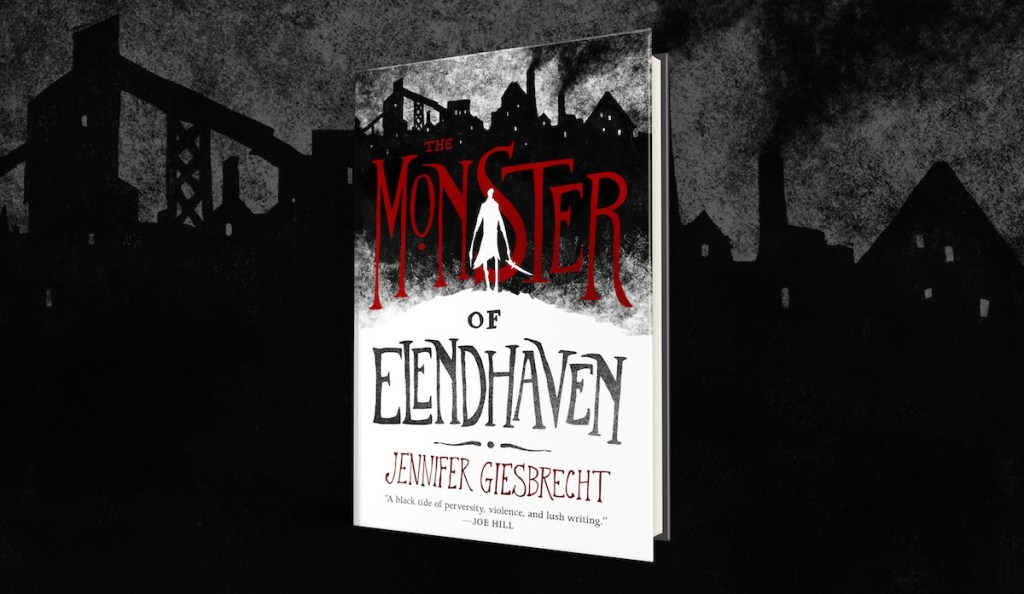
Book Review: The Monster of Elendhaven

One of the first books I read for my 2020 “Storm the Castle” Reading Challenge was the novella The Monster of Elendhaven by Jennifer Giesbrecht. I read this book on Audible (a good majority of my reading is done through audiobooks these days). It is a fantasy/horror story and it was a) very dark and twisted, b) very good, and c) very gay. I loved it!

I used to write book reviews semi-regularly, but I am very out of practice so this will probably not be horribly structured or formal. And I haven’t decided how I am going to quantify my feelings into a number or star system, so that’s very up-in-the-air right now… (shrug). That said, I will try to keep this review from being TOO spoilery, while still providing enough information for you to decide if this book sounds like something you’d like to check out or not.

The city of Elendhaven lies in the far north, on the edge of a dark, mysterious ocean. It is a city filled with gruesome myths and haunted by plague and betrayal and death. In this city, the story begins with the “birth” or perhaps “creation” of the main character: a creature shaped like a man but not entirely human, a thing with no name until he baptizes himself and decides his name is now Johann. Johann, tall and dark and menacing, yet somehow nearly invisible in society, quickly learns how to make a “living” for himself by whatever criminal and violent means necessary: stealing, stalking, killing, etc. He also discovers that he, apparently, cannot die. Stabbed, beaten, jumping off very tall buildings… it doesn’t matter the method, he does not die.

In the course of his criminal endeavors, Johann begins stalking a wealthy young man he sees often in the bars around the city, named Florian. Florian is small and frail and almost femininely-pretty, but when Johann finally attacks him in a dark alley, Florian is unafraid and unimpressed, but intrigued by the possibilities Johann’s talents might afford him. Florian is, in fact, a sorcerer… possibly the very last one of a breed who have been hunted and executed to near-extinction.

Thus begins a dark, twisted partnership as Johann becomes Florian’s willing servant on a mission of depraved science experiences, murder, and revenge. 

oil slick stock image

This novella is black as pitch, sleek and glimmering and beautiful and yet greasy, like an oil slick. It is amazing how much of a punch it packs in a slim 160 pages (about 4.5 hrs on my audiobook)! Johann is violent and terrifying, yet strangely guileless – obsessed with, enamored of delicate but depraved, nearly-heartless Florian. The relationship between the two is a tangle of fascination, disgust, obsession, and deeply-buried genuine affection. And Florian’s plans and motives are so secretive and mysterious that it takes the entirety of the novella to really put together all the pieces. (At one point I thought Florian might be trans, but I was wrong. Gay as shit though). The story is half-horror as Florian instructs Johann to carry out his ruinous revenge of the city and the people who had so horribly wronged him and his family; and it is half-romance as Johann tries to charm Florian with his bizarre mix of flattery, affection, and sado-masochistic penchant for violence.

Jennifer Giesbrecht’s prose is wonderfully baroque, gothic, and poetic. The language lingers, takes it time, stays on the tongue and against the teeth. It features such lines as:

“Power was sweeter than apples. It was cheaper than water, and sustained the soul twice as well. If Johann was going to be a Thing with a name, then from now on he would be a Thing with power, too.”

— Jennifer Giesbrecht, The Monster of Elendhaven

And the first description of the city of Elendhaven is nicely indicative of the tone and style as well:

“Southerners called its harbour the Black Moon of Norden; a fetid crescent that hugged the dark waters of the polar sea. The whole city stank of industry. The air was thick with oil, salt, and smoke, which had long settled into the brick as a slick film, making the streets slippery on even the driest days. It was a foul place: foul scented, foul weathered, and plagued with foul, ugly architecture—squat warehouses peppered with snails and sea grass, mansions carved from heavy, black stone, their thick windows stained green and greasy from exposure to the sea. The tallest points in Elendhaven were the chimneys of the coal refineries. The widest street led south, rutted by the carts that dragged whale offal down from the oil refineries.
Hundreds of years ago, the North Pole had been cut open by searing magic, a horrific event that left the land puckered with craters like the one Elendhaven huddled in. For five centuries, the black waters had been poisoned with an arcane toxin that caused the skin to bubble and the mind to go soggy and loose like bread in broth. Once in a while, the fishermen would pull up an aberration from the ocean floor: something frothing and wet with its insides leaking out its eyes. ‘Demons and monsters,’ visitors whispered, ‘such creatures still sleep inside the Black Moon.’”

— Jennifer Giesbrecht, The Monster of Elendhaven

I’ve seen a few reviews of this novella online. Some people really liked it, and others gave it a tepid response, claiming that it starts well but is missing something. I’ll be honest, I’m not sure what they think is missing. Sure, the ending is ambiguous and open-ended, but I think that is all to its merit. I admit I do wonder what could have been, had this story been fleshed out into a full-length novel, but in general I love novellas – I love the big explosive power of the tiny package – and I think this novella works very well. I really enjoyed it, and I believe anyone who likes their fantasy with a horror-twist and a bit of a gut-punch will enjoy it as well.

I’m still shaking out how to do my reviews, but for now I’d say it’s a 4.5 out of 5 stars.

For more info:

You can read the first chapter on tor.com’s site here

You can also check out the author’s playlist and some fanart on Jennifer Giesbrecht’s website here