
For a recent freelance project, I found myself revisiting some time travel narratives. Years ago I taught an entire course on time travel narratives, and it was fun to have an opportunity to dig up those old lecture notes, and re-read a couple of the novels and short stories I taught in that course. I had mentioned at the beginning of the year that I might like to re-purpose some of that work for the blog, since its become abundantly clear I’m not likely to go back into teaching any time soon and all that work might as well be put to some kind of use.
SO! I’ll be doing a handful of blog posts in a sequence about time travel. I promise not to go on about too long, but I thought it might be fun. I’ll start with a brief overview (here), and then discuss perhaps just a couple of novels and a short story or two, and end with a full reading list (and viewing list as well — since there’s some great time travel stuff in film and television). I hope that sounds like fun! It’s fun for me at least.
So without further ado: A Brief History of Time Travel

Time travel exists as a philosophical concept, a scientific principle, and narrative subgenre. The possibilities and implications of time travel have been explored for centuries and appear in many different cultures. While time travel as imagined in fiction may not be possible, some scientists argue that one-way time travel might be possible through the concept of time dilation in the special theory of relativity.
Time travel, as a narrative subgenre, exists in both fantasy and science fiction, but its earliest appearances are in myth and folklore. Two of the oldest examples are “The Tale of Kakudmi” in Hindu mythology. and “The Tale of Urashima Taro” in Japanese folklore.

“The Tale of Kakudmi” appears in several Hindu texts, most prominently the Vishnu Purana (Book IV, Ch 1) — one of 18 important ancient Hindu texts that contain stories of the Hindu gods, kings, and dynasties. When the Vishnu Purana was written is highly contested, but some estimates suppose it to be as old as 1000 BCE. “The Tale of Kakudmi,” briefly, is this:
Kakudmi was a king with a daughter named Revati. Revati was so beautiful that Kakudmi believed no one upon the Earth was worthy enough to marry her. So they went to the Hindu god Brahma to ask for advice, giving him a list of possible suitors and asking which is most worthy. However, Brahma informs them that time moves differently for the gods, and by teh time Kakudmi and Revati return from their visit with Brahma, everyone they have ever known will be long dead. In the short time Kakudmi and Revati are with Brahma, 27 catur-yugas have passed among men (1 catur-yuga = approx. 4,320,000 years according to the Vishnu Purana; so 27 catur-yugas = approx. 116,640,000 years). When Kakudmi and Revati return, they find that no only have the landscape and environment changed drastically, but that the civilizations of men have declined, becoming less than they were in Kakudmi’s own time. Kakudmi states that “he found the race of men dwindled in stature, reduced in vigour, and enfeebled in intellect,” thus making them even less worthy of his daughter than they had been in his own time.
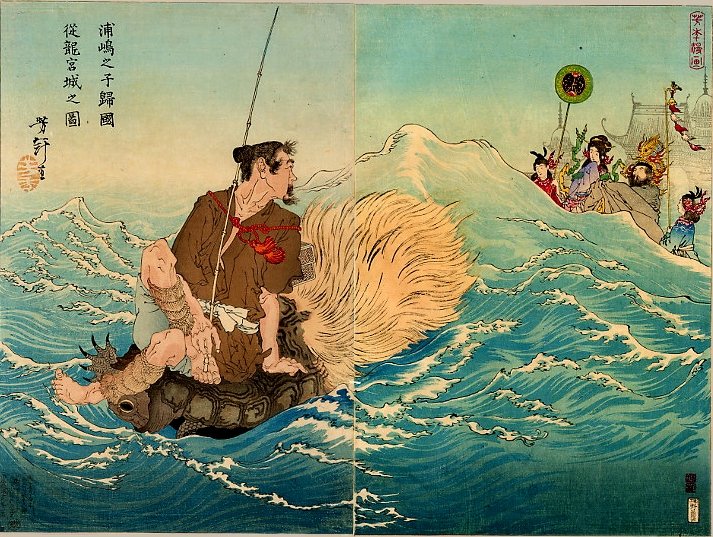
“The Tale of Urashima Taro” is from Japanese folklore, first seen in the Nihongi, the second oldest book of classical Japanese history, and perhaps written around the 6th century. Like “The Tale of Kakudmi,” Urashima Taro is the story of a man who goes to a supernatural location, where time moves differently, so that he experiences only a handful of days while 300 years pass for normal men.
Both of these stories could be considered very early examples of the concept of time dilation, in which time moves more quickly or slowly depending on where you are, based on the theory of relativity that states all perceptions of time differ for different people in different places.
The earliest time travel in stories happened though magical or mystical means: a god, a spell, a mysterious realm. For instance, in the play Anno 7603 by Norwegian poet Johann Hermann Wessel, written in 1781, two men are sent far into the future by a good fairy, where they find that gender roles have reversed and only women are allowed to fight in the military. Then there is, of course, the case of the short story “Rip Van Winkle” by Washington Irving, published in 1918, in which a man mysteriously falls asleep and wakes up decades later without explanation.
The oldest known story of time travel by means of a machine is Edward Page Mitchell’s “The Clock That Went Backward,” written in 1881, though even this story is more magical than science-fictional. It was H. G. Wells’s famous novella The Time Machine (1895) that truly popularized the idea of time travel through scientific and mechanical means; however his short story, “The Chronic Argonauts,” includes a time machine as well, and predates the Time Machine by seven years.
The method used in the highly-regarded novel Time and Again (which will be discussed in my next post) travel is loosely inspired by Einstein’s theories of time, based on the Special Theory of Relativity, combined with the concept of “self-hypnosis.” This method was also popularized in the novel Bid Time Return by Richard Matheson (most famous for I Am Legend and What Dreams May Come), which inspired the film Somewhere in Time starring Christopher Reeve.
Since then, time travel has remained a popular trope in both fantasy and science fiction stories in both print and visual media. Many science fiction stories take great pains to offer detailed explanations for how and why time travel works. But in just as many stories, the how and why of time travel is ignored in favor of the social, historical, or personal consequences of that travel. In some cases, the time travel is merely a trope used to propel another kind of story, such as in the Outlander series (books and tv show), where the time travel elements are mostly used to allow for the romantic drama.

Literature scholar David Wittenberg argues that time travel fiction is a kind of “narratological laboratory” in which the “most basic theoretical questions about storytelling,” as well as philosophical concepts of “temporality, history, and subjectivity, are represented in the form of literal devices and plots,” for the purpose of exploration, through experiments, analysis, and criticism (Wittenberg, David. Time Travel: The Popular Philosophy of Narrative. Fordham UP, 2013).
Some of the most popular themes within time travel narratives include: fears or hopes of changing the past, alternate pasts and alternate futures, observing or communicating with another time, time loops and time paradoxes, time wars, and the prevalence of human emotions such as love overcoming the obstacles of time.
 Amanda Haimoto Rudd