
I thought briefly that I might write a post about The Time Machine by H.G. Wells, but then I decided that the book (and the many movie versions) are so well-known, and have been discussed by so many smart people, that it would feel a bit redundant for me to do so now. So, I thought I instead that I might talk about a book or two that, while very well-regarded in their time, have not remained as instantly-recognizable with current readers as they should be. And I’m starting with this one: Time and Again by Jack Finney.
I recently had the opportunity to re-read this classic of time travel fiction, which I had read a couple decades ago but didn’t remember much about. I wanted to share a bit about this truly excellent novel, and hopefully encourage more people to read it now.
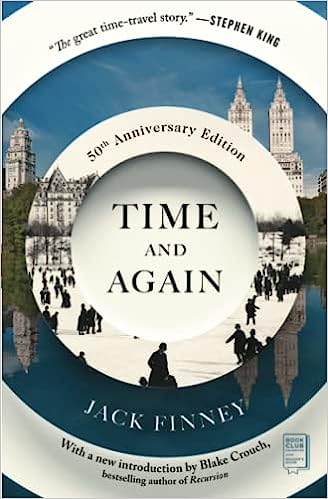
Time and Again (1970), an illustrated science fiction time travel novel by American author Jack Finney, follows Simon “Si” Morley as he is recruited to a secret government time travel project, and succeeds in traveling to 1882. There, Si tries to unravel a possible conspiracy, falls in love, and faces difficult choices between love and obligation, loyalty and ethical duty. This is the first of two novels, with the sequel From Time to Time (1995) published the year Jack Finney died. Finney left the ending open for a third novel that was never written.
Many of Jack Finney’s short stories and novels had commercial and critical success. His first novel, 5 Against the House, was published in 1954 and made into a movie in 1955. He is most famous for his second novel, The Body Snatchers (1955), which became his most commercially successful venture, spawning the 1956 movie Invasion of the Body Snatchers and its many remakes. Five of Finney’s novels and several short stories were adapted for film and television in his lifetime. However, his greatest critical success came with Time and Again, which remains his most highly-regarded work by fans and critics alike.
In the introduction to the 50th Anniversary edition of Time and Again, science fiction author Blake Crouch credits Jack Finney and this novel with starting him on the path to becoming a best-selling science fiction writer. And Stephen King, in the Afterword for his novel 11/22/63, claims it is “in this writer’s humble opinion, the great time-travel story.”
In Time and Again, the main character, Si Morley, works as an illustrator for an advertising agency in 1970s New York City, where he is dissatisfied with his life, and bored at work, with no family and a few lackluster romantic relationships. One day he receives a visitor at work, a man named “Rube” Prien–a Major in the Army, who has come to recruit Si to a top-secret government project: an experiment in time travel devised by Dr. E. E. Danziger.
Danziger, a physicist, believes he has devised a method of time travel: by tricking the brain into believing a person is already in a physical location in the past, one can become detached from their own time, and travel back in time.
Si is skeptical at first, but ultimately agrees to join the experiment if he is permitted to travel to New York in January 1882, to witness the mailing of a letter and unravel a mystery that has been haunting him and his girlfriend, Kate. Kate’s father gave her a letter once mailed to HIS father, Andrew Carmody in January 1882 – a letter that hints at a fire that may destroy the world, and was somehow connected to Carmody’s suicide years later. Si intends to learn who sent that letter and what it really means.
And so Si’s adventures in time travel begin. He travels back and forth between 1882 and the 1970s several times, uncovering a larger mystery than he could have guessed, and accidentally falling in love in the process. In his efforts to solve the mystery of the letter, he will come face to face with complex ethical questions about the limits of scientific discovery, the moral obligations of those in power, the dangers of messing with the timeline, the inevitability of fate, and what it means to find the place where you belong.
This book is widely considered a masterpiece of the time travel narrative genre. It features rich detailed descriptions of New York City in the 1880s that beautifully make the time period and setting come alive. This is aided by Finney’s meticulous use of real drawings and photographs from the time period (which he attributes to his fictitious characters), and even quotes and clippings from newspapers of the time. The characters are complex, with deep emotional resonance, genuine motivations, and rich histories. Finney treats even many of the briefly-mentioned side characters with careful attention and detail.
In addition, the narrative voice of Si Morley (the story being written in first person POV) as Morley relaying his experiences, is intelligent, wry, and humorous. Si’s sarcastic wit is often on display, both in his descriptions and in his dialogue with other characters. And his observations about humanity are thought-provoking and insightful.
Over fifty years later, Time and Again is still as impressive as it was upon its initial release. Despite a few outdated statements, it continues to be philosophically rigorous, utterly fascinating, beautifully written, and highly entertaining. I strongly believe it will remain a high benchmark for the genre for decades to come.
 Amanda Haimoto Rudd