Book Review: Middlegame

Book: Middlegame
Author: Seanan McGuire
Release Date: May 2019
Source: ARC provided by publisher, then audiobook bought from Audible
Rating: 5 out of 5 stars

Seanan McGuire is a very prolific writer. She has written two different urban fantasy series (The October Daye books and the inCryptid books). She has written a bunch of horror novels, including the acclaimed Newsflesh Trilogy under the pen name Mira Grant. And she has gained, probably, her most impressive accolades from her novella Wayward Children series, the first of which – Every Heart a Doorway – was how I came to her in the first place.

Middlegame is a standalone fantasy novel (which I really appreciated! I love a good epic fantasy series but sometimes they get too exhausting and I enjoy a good immersive standalone book). And guys, it is SO GOOD.

I first started reading it in April 2019, when I borrowed an ARC through my work. However, I only got about a third of the way through it before various issues got in the way and I never finished it. And then I returned the ARC to my employer and that was that. So, when I started my “Storm the Castle” 2020 Reading Challenge with my friends, I knew that Middlegame would be on the list of books in the “Books You Started But Never Finished” Category.

A few weeks ago I caved in and just bought the audiobook. Even though I am slowly getting better at reading print books again, I still do the majority of my reading through audiobooks, especially because I can often listen to them while I’m working. It took me quite awhile to finish the audiobook of Middlegame though, for a few reasons: first off, I started it but then decided I really REALLY just wanted to finish the book Lawrence in Arabia first because it had stolen all my attention; second, the plot of Middlegame was stressing me out so much and giving me so much anxiety that I had trouble listening to it for more than half an hour at a time; and third, I didn’t really care for the narrator, Amber Benson.

Amber Beson is the actress who portrayed Tara in Buffy the Vampire Slayer, and by and large I really do like her as an actress. But no matter how hard I tried to get used to her, I just did not like her narration – especially her voices for two of the antagonists, Reed and Leigh. Her voices for the two main characters I didn’t LOVE, but I could handle. Her voices for the two villains just set my teeth on edge every single time. So, that didn’t help. But oh well.

The story itself, however, is AMAZING. I’m going to try to explain what is a rather complex premise and plot without giving away anything too spoilery (I know its been out for almost a year but I still would like to avoid spoilers if I can).

Middlegame is set in a version of America where alchemy exists in secret all around us. Asphodel Baker, one of the great alchemists of her age, sets out to lead humanity to a kind of utopic vision called “The Impossible City” by embodying something called the “Doctrine of Ethos” – a kind of philosophical and magical concept that controls (or perhaps more accurately, creates?) reality – into a biddable human form. However, Asphodel Baker can’t do this on her own, and when her greatest alchemical creation – her protege Reed – kills her, he takes over her task with the help of violent, I would say INSANE, golem-woman named Leigh. And together they create a group of children, created in pairs as twins, with rhyming names, who each MIGHT come to embody the doctrine as they grow.

To be clear, all that is just the PROLOGUE. Stay with me!

The MAIN plot of the book follows one set of these pairs, brother and and sister Roger and Dodger. The twins have been separated at birth by Reed and his associates, but discover each other when they realize they can see through each other’s eyes and speak to each other in their minds despite living on opposite coasts. They do not know WHY or HOW they can do this, and decide they must be quantum-entangled somehow but since they are kids they don’t question it much. They grow up on opposite sides of the country as best friends, but as they become teenagers and then adults a variety of incidents keep tearing them apart (I’m trying really hard not to get spoilery here, folks). They keep coming back together again, and then splitting up, over and over. It was very stressful for me!

Finally, as adults, they reunite one last time as they realize that a) they were created beings, not born in the traditional sense, and b) their creator might be trying to kill them.

The plot of this novel is enormously complex. There are several important characters to keep track of, one of whom you don’t realize will be important until much later in the book. Parts of the novel are told out of chronological order: the book is organized into Parts 1-7, but it continues to return to Part 7 THROUGHOUT the novel! In addition, each part is prefaced with a passage from “Over the Woodward Wall” which is a children’s book that exists in-world for the characters (but not for us) written by Asphodel Baker to indoctrinate children to her ideas. (Fun fact: Seanan McGuire is now actually WRITING this not-real book and it is being published by Tor). On top of all this: there’s TIME TRAVEL in the book. Quite a lot of time travel in the second half (I hope that doesn’t give away too much!).

As I said earlier, this book gave me a lot of stress and anxiety. I want to be clear that this is not a mark against it! It just goes to show how REAL the characters were to me, and how tightly, tensely written the plot was! Every time the two main characters, Roger and Dodger, got separated, or were put in danger, I got very stressed!

This book is brutal and cruel. Both to its characters and to its readers. It is almost physically painful to read. On the other hand, Seanan McGuire’s writing always has a beautiful, almost poetic quality to it. It is especially noticeable in her Wayward Children series, but it is also in evidence here. Some of the passages are just SO PRETTY. Here’s just a few examples:

“Words can be whispered bullet-quick when no one’s looking, and words don’t leave blood or bruises behind. Words disappear without a trace. That’s what makes them so powerful. That’s what makes them so important. That’s what makes them hurt so much.”

“Maybe it would be comforting, to her. The math would be true, and that’s all she’s ever asked from the world. He knows the words that apply to this situation—exsanguination, hypovolemia, hemorrhage— but they don’t reassure him the way the numbers reassure her. They never have. Numbers are simple, obedient things, as long as you understand the rules they live by. Words are trickier. They twist and bite and require too much attention. He has to think to change the world. His sister just does it.”

“For a man on a mission, a hundred years can pass in the blinking of an eye. Oh, it helps to have access to the philosopher’s stone, to have the fruits of a thousand years of alchemical progress at one’s fingertips, but really, it was always the mission that mattered. James Reed was born knowing his purpose, left his master in a shallow grave knowing his purpose, and fully intends to ascend to the heights of human knowledge with the fruits of his labors clutched firmly in hand. Damn anyone who dares to get in his way.”

“She looks like peaches and cream, like Saturday afternoons down by the frog pond, innocence and the American dream wrapped up in a single startlingly lovely package. It’s a lie, all of it. He believes in exploiting the world for his own gains, but she’d happily ignite the entire thing, if only to roast marshmallows in its embers.”

There is also something to be said about determination and hope in this book. These characters balance just on the edge of giving up and giving in every other page, and yet somehow manage to keep trying and keep fighting, in the face of failure and death and worse. And it is also about love – familial love, the love for family and friends, rather than romantic love. And that was something else I really appreciated about this book. No knock on romance – I love a good romance – but this was something different. You’re going to think this is a weird comparison – but it is different in the way Lilo & Stitch was different from the usual “princess falls in love” Disney fare. As someone with three siblings, it was something I could really appreciate (even if I don’t get along quite so well with my siblings as Roger and Dodger do).

All in all, I really enjoyed this book. Just as I have enjoyed everything I have read by Seanan McGuire so far (and I have so much more of hers to read!). I highly recommend this book. Just… maybe not the audio version…

And, even though I didn’t intentionally time the finishing of this book and the writing of this review quite so well on purpose, it is actually quite nicely timed because the trade paperback printing of Middlegame is being released on April 7th. So you can pre-order if you like! How apropos is that?!

For links to buy the book: Amazon, Barnes & Noble, Indiebound

And Tor.com has a couple passages available to read on their website as well: from Part One and Part Four
Book Review: Steel Crow Saga

My second official book review for the new blog is here!

As I mentioned previously, I read Steel Crow Saga near the end of 2019, and it was definitely one of my favorite books of the year. As with most of my reading lately, I read this book on Audible (remind me to more fully sing the praises of Audible later, folks!)

So, to the point!

Book: Steel Crow Saga
Author: Paul Krueger
Source: Bought on Audible
Rating: 5 out of 5 Stars

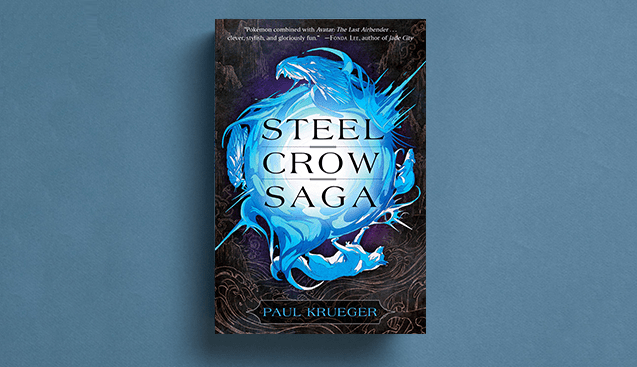
Steel Crow Saga is an absolutely brilliant new fantasy novel (released Sept 2019) by Paul Krueger (this is his second book, having published Last Call at the Nightshade Lounge in 2016 – though I haven’t read that one, I now plan to). In its early marketing it was the tagline “Pokémon combined with Avatar the Last Airbender” (quoted from Fonda Lee) and let me start by saying that that comparison holds up in the best way possible! It was the tagline that sold me on the book (I’m all here for more fantasy and SF writers not only being influenced by anime but actually ADMITTING to it), and I was NOT disappointed.

The world of Steel Crow Saga is inspired by Asian cultures and has a vaguely 1910-1920s feel (it is clearly not modern, there is a somewhat “old-world” feel to it, but there are trains and rudimentary cars, and radio, so…). There are four main Asian-esque countries involved: The Tomoda Empire (based on Japan), the Shang Dynasty (China), The Sanbu Islands (The Philippines), and Jeongson (Korea) with a vaguely Indian-inspired people on the outskirts. Long before the beginning of the novel, The Tomoda Empire had conquered and colonized the other three… If this all has a very ATLA feel to it, you are right… Paul Krueger leans into the comparisons and the homages with joy and abandon, but it never feels like a copy or a rip-off.

The real plot of the novel picks up just after the three colonized countries (Sanbuna, Jeongson, and Shang) have risen up in an enormous rebellion/war and overthrown the Tomoda Empire, and follows the progress of four main characters.

First, there is Prince Jimuro: a prisoner of war for the last two years of the rebellion, Jimuro is the last surviving member of the imperial family of Tomoda, who inherits his throne from the ashes of a defeat. Now he is being permitted by the victors to ascend to his throne in order to solidify Tomoda’s surrender and forge a new peace.

Then there is Tala, a battle-hardened soldier from the Sanbu Islands, who has lost everything she ever loved in the course of the war and carries a terrible, damning secret. She has been tasked with the mission to deliver Jimuro safely to his throne while evading many opposing forces that wish to stop them, and despite the fact that she hates him with a deep, cold fury.

Third is Xiulan, a low-ranking princess of the Shang Dynasty who has become a detective after the style of her favorite (Sherlock Holmes-esque) book character, and who secretly plans to bypass her despised oldest sister to first in line for the throne, by presenting her father with the war criminal Prince Jimuro.

Lastly, there is Lee, a thief and con-artist from an oppressed population within Jeongson, betrayed by her latest partner, whose one rule – “leave them before they leave you” is challenged when Princess Xiulan saves her from the gallows in order to enlist her to the mission to track down and capture Prince Jimuro.

These four characters begin with separate missions and motivations, working along different paths (physically and metaphorically) but will encounter each other and entangle as the narrative progresses. In addition to this four main players, however, we also a have a wide cast of highly important supporting characters including Tala’s brother Dimangan, Jimuro’s childhood friend who happens to be trans, Xiulan’s devious but strangely-compelling oldest sister, and, of course, the primary antagonist who remains nameless through most of the story: a terrifyingly powerful and mysterious man in a long purple coat who has abilities no one should have.

And then there are the shades. This is where the Pokemon references come in, because many of the people in this world have the ability to do what is called “Shade-Pacting” – choosing an animal companion (or more to the point letting the animal choose you) and, essentially, merging parts of your souls to become partners, with the animal shade now living inside you, ready to be called to battle at the call of their name. Tala’s shade companion is a crow. Xiulan possesses a white rat. Lee wants nothing more than to have a shade of her own, despite the fact that her people have never before been allowed to learn how to pact with one. And Jimuro’s people, the Tomodanese find the practice of pacting to be akin to slavery, an act so disgusting to them that it had become one of their most prevalent excuses for colonialism – to stop the Shang and Sanbuna peoples from practicing this barbaric tradition.

To say this novel is jam-packed with world-building and action would be a massive understatement. Paul Krueger constructs this world with an astounding attention to detail, “creating a rich new mythology and characters so real you can smell their pipe smoke and adobo” as Delilah S. Dawson in her blurb for the book. The writing is rich and potent, with the fun addition of dozens of nerdy references (to anime, to movies, to other books, etc) and easter eggs – some of which I still have not identified if Paul Krueger’s twitter feed is to be believed. The action is fast-paced and exciting, with fight sequences that on one hand seem MADE for film, and on the other hand are so deftly described that you can picture them easily without visual aid.

The character development is also written with compassion, sensitivity, and beauty. The characters challenge each other’s prejudices and flaws, learn from each other organic ways, and build relationships and romances with touching, intense, and sometimes comedic, authenticity.

In addition to all of this, the novel is also exceptionally socially and politically aware. It features two bisexual characters, a gay character, and a trans character, all of whom are fully-realized and compassionately written (even when they are being idiots and/or assholes), and who are treated as nothing unusual or Othered by the narrative. The narrative and the characters also reveal and interrogate the complexities of imperialism, colonialism, and racial/ethnic prejudice with the incisiveness, intensity, humanity, and intellectual rigor one might expect in a particularly-well written philosophical or political thesis.

In other words, I really cannot sing this book’s praises loudly enough.

As I wrote in a tweet right after finishing it last year, “come for the kickass magic and fight scenes, stay for the excellent examination of colonialism, imperialism, racial/ethnic prejudice, and family loyalty…”

Can I give it 6 out of 5 stars? Is that allowed? Too bad, I’m doing it anyway!

For more info:

You can read  the first two chapters here on tor.com

You can also read more praise of the book and here an excerpt from the audiobook on the Penguin Random House website

And the paperback printing is being released in May! You can pre-order that on Amazon, Barnes & Noble, or Indiebound

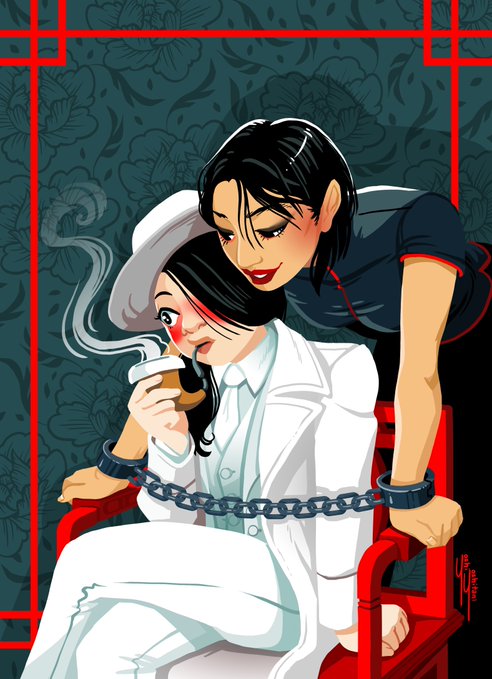
Lastly, here’s a piece of art Paul Krueger himself commissioned from artist Yoshi Yoshitani, of the two character Lee and Xiulan:

Book Review: The Monster of Elendhaven

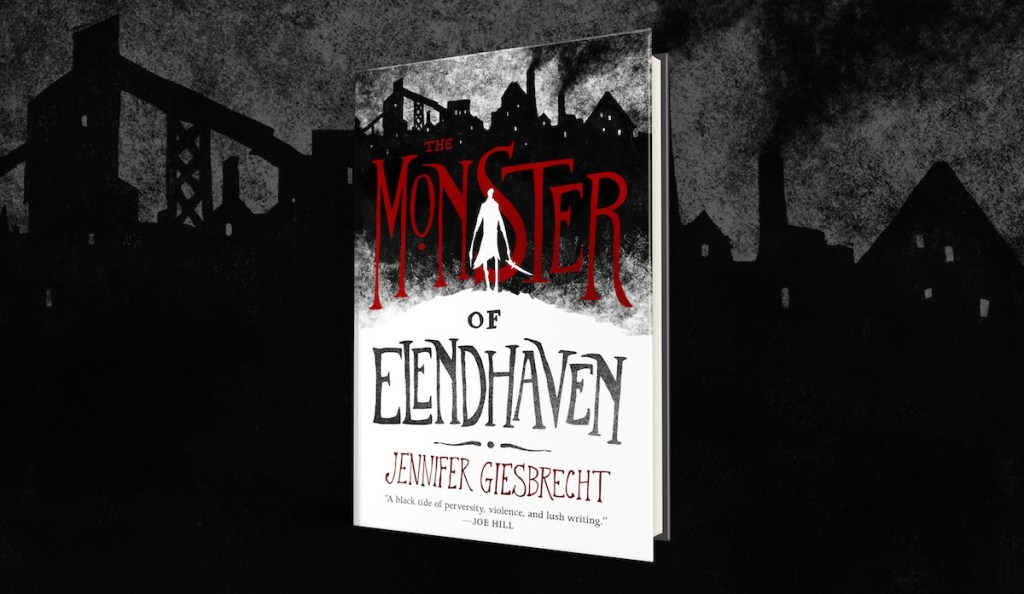
One of the first books I read for my 2020 “Storm the Castle” Reading Challenge was the novella The Monster of Elendhaven by Jennifer Giesbrecht. I read this book on Audible (a good majority of my reading is done through audiobooks these days). It is a fantasy/horror story and it was a) very dark and twisted, b) very good, and c) very gay. I loved it!

I used to write book reviews semi-regularly, but I am very out of practice so this will probably not be horribly structured or formal. And I haven’t decided how I am going to quantify my feelings into a number or star system, so that’s very up-in-the-air right now… (shrug). That said, I will try to keep this review from being TOO spoilery, while still providing enough information for you to decide if this book sounds like something you’d like to check out or not.

The city of Elendhaven lies in the far north, on the edge of a dark, mysterious ocean. It is a city filled with gruesome myths and haunted by plague and betrayal and death. In this city, the story begins with the “birth” or perhaps “creation” of the main character: a creature shaped like a man but not entirely human, a thing with no name until he baptizes himself and decides his name is now Johann. Johann, tall and dark and menacing, yet somehow nearly invisible in society, quickly learns how to make a “living” for himself by whatever criminal and violent means necessary: stealing, stalking, killing, etc. He also discovers that he, apparently, cannot die. Stabbed, beaten, jumping off very tall buildings… it doesn’t matter the method, he does not die.

In the course of his criminal endeavors, Johann begins stalking a wealthy young man he sees often in the bars around the city, named Florian. Florian is small and frail and almost femininely-pretty, but when Johann finally attacks him in a dark alley, Florian is unafraid and unimpressed, but intrigued by the possibilities Johann’s talents might afford him. Florian is, in fact, a sorcerer… possibly the very last one of a breed who have been hunted and executed to near-extinction.

Thus begins a dark, twisted partnership as Johann becomes Florian’s willing servant on a mission of depraved science experiences, murder, and revenge. 

oil slick stock image

This novella is black as pitch, sleek and glimmering and beautiful and yet greasy, like an oil slick. It is amazing how much of a punch it packs in a slim 160 pages (about 4.5 hrs on my audiobook)! Johann is violent and terrifying, yet strangely guileless – obsessed with, enamored of delicate but depraved, nearly-heartless Florian. The relationship between the two is a tangle of fascination, disgust, obsession, and deeply-buried genuine affection. And Florian’s plans and motives are so secretive and mysterious that it takes the entirety of the novella to really put together all the pieces. (At one point I thought Florian might be trans, but I was wrong. Gay as shit though). The story is half-horror as Florian instructs Johann to carry out his ruinous revenge of the city and the people who had so horribly wronged him and his family; and it is half-romance as Johann tries to charm Florian with his bizarre mix of flattery, affection, and sado-masochistic penchant for violence.

Jennifer Giesbrecht’s prose is wonderfully baroque, gothic, and poetic. The language lingers, takes it time, stays on the tongue and against the teeth. It features such lines as:

“Power was sweeter than apples. It was cheaper than water, and sustained the soul twice as well. If Johann was going to be a Thing with a name, then from now on he would be a Thing with power, too.”

— Jennifer Giesbrecht, The Monster of Elendhaven

And the first description of the city of Elendhaven is nicely indicative of the tone and style as well:

“Southerners called its harbour the Black Moon of Norden; a fetid crescent that hugged the dark waters of the polar sea. The whole city stank of industry. The air was thick with oil, salt, and smoke, which had long settled into the brick as a slick film, making the streets slippery on even the driest days. It was a foul place: foul scented, foul weathered, and plagued with foul, ugly architecture—squat warehouses peppered with snails and sea grass, mansions carved from heavy, black stone, their thick windows stained green and greasy from exposure to the sea. The tallest points in Elendhaven were the chimneys of the coal refineries. The widest street led south, rutted by the carts that dragged whale offal down from the oil refineries.
Hundreds of years ago, the North Pole had been cut open by searing magic, a horrific event that left the land puckered with craters like the one Elendhaven huddled in. For five centuries, the black waters had been poisoned with an arcane toxin that caused the skin to bubble and the mind to go soggy and loose like bread in broth. Once in a while, the fishermen would pull up an aberration from the ocean floor: something frothing and wet with its insides leaking out its eyes. ‘Demons and monsters,’ visitors whispered, ‘such creatures still sleep inside the Black Moon.’”

— Jennifer Giesbrecht, The Monster of Elendhaven

I’ve seen a few reviews of this novella online. Some people really liked it, and others gave it a tepid response, claiming that it starts well but is missing something. I’ll be honest, I’m not sure what they think is missing. Sure, the ending is ambiguous and open-ended, but I think that is all to its merit. I admit I do wonder what could have been, had this story been fleshed out into a full-length novel, but in general I love novellas – I love the big explosive power of the tiny package – and I think this novella works very well. I really enjoyed it, and I believe anyone who likes their fantasy with a horror-twist and a bit of a gut-punch will enjoy it as well.

I’m still shaking out how to do my reviews, but for now I’d say it’s a 4.5 out of 5 stars.

For more info:

You can read the first chapter on tor.com’s site here

You can also check out the author’s playlist and some fanart on Jennifer Giesbrecht’s website here