
My second official book review for the new blog is here!
As I mentioned previously, I read Steel Crow Saga near the end of 2019, and it was definitely one of my favorite books of the year. As with most of my reading lately, I read this book on Audible (remind me to more fully sing the praises of Audible later, folks!)
So, to the point!
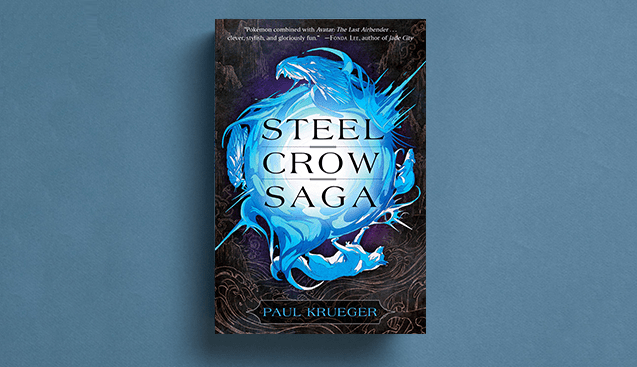
Book: Steel Crow Saga
Author: Paul Krueger
Source: Bought on Audible
Rating: 5 out of 5 Stars
Steel Crow Saga is an absolutely brilliant new fantasy novel (released Sept 2019) by Paul Krueger (this is his second book, having published Last Call at the Nightshade Lounge in 2016 – though I haven’t read that one, I now plan to). In its early marketing it was the tagline “Pokémon combined with Avatar the Last Airbender” (quoted from Fonda Lee) and let me start by saying that that comparison holds up in the best way possible! It was the tagline that sold me on the book (I’m all here for more fantasy and SF writers not only being influenced by anime but actually ADMITTING to it), and I was NOT disappointed.
The world of Steel Crow Saga is inspired by Asian cultures and has a vaguely 1910-1920s feel (it is clearly not modern, there is a somewhat “old-world” feel to it, but there are trains and rudimentary cars, and radio, so…). There are four main Asian-esque countries involved: The Tomoda Empire (based on Japan), the Shang Dynasty (China), The Sanbu Islands (The Philippines), and Jeongson (Korea) with a vaguely Indian-inspired people on the outskirts. Long before the beginning of the novel, The Tomoda Empire had conquered and colonized the other three… If this all has a very ATLA feel to it, you are right… Paul Krueger leans into the comparisons and the homages with joy and abandon, but it never feels like a copy or a rip-off.
The real plot of the novel picks up just after the three colonized countries (Sanbuna, Jeongson, and Shang) have risen up in an enormous rebellion/war and overthrown the Tomoda Empire, and follows the progress of four main characters.

First, there is Prince Jimuro: a prisoner of war for the last two years of the rebellion, Jimuro is the last surviving member of the imperial family of Tomoda, who inherits his throne from the ashes of a defeat. Now he is being permitted by the victors to ascend to his throne in order to solidify Tomoda’s surrender and forge a new peace.
Then there is Tala, a battle-hardened soldier from the Sanbu Islands, who has lost everything she ever loved in the course of the war and carries a terrible, damning secret. She has been tasked with the mission to deliver Jimuro safely to his throne while evading many opposing forces that wish to stop them, and despite the fact that she hates him with a deep, cold fury.
Third is Xiulan, a low-ranking princess of the Shang Dynasty who has become a detective after the style of her favorite (Sherlock Holmes-esque) book character, and who secretly plans to bypass her despised oldest sister to first in line for the throne, by presenting her father with the war criminal Prince Jimuro.
Lastly, there is Lee, a thief and con-artist from an oppressed population within Jeongson, betrayed by her latest partner, whose one rule – “leave them before they leave you” is challenged when Princess Xiulan saves her from the gallows in order to enlist her to the mission to track down and capture Prince Jimuro.
These four characters begin with separate missions and motivations, working along different paths (physically and metaphorically) but will encounter each other and entangle as the narrative progresses. In addition to this four main players, however, we also a have a wide cast of highly important supporting characters including Tala’s brother Dimangan, Jimuro’s childhood friend who happens to be trans, Xiulan’s devious but strangely-compelling oldest sister, and, of course, the primary antagonist who remains nameless through most of the story: a terrifyingly powerful and mysterious man in a long purple coat who has abilities no one should have.
And then there are the shades. This is where the Pokemon references come in, because many of the people in this world have the ability to do what is called “Shade-Pacting” – choosing an animal companion (or more to the point letting the animal choose you) and, essentially, merging parts of your souls to become partners, with the animal shade now living inside you, ready to be called to battle at the call of their name. Tala’s shade companion is a crow. Xiulan possesses a white rat. Lee wants nothing more than to have a shade of her own, despite the fact that her people have never before been allowed to learn how to pact with one. And Jimuro’s people, the Tomodanese find the practice of pacting to be akin to slavery, an act so disgusting to them that it had become one of their most prevalent excuses for colonialism – to stop the Shang and Sanbuna peoples from practicing this barbaric tradition.
To say this novel is jam-packed with world-building and action would be a massive understatement. Paul Krueger constructs this world with an astounding attention to detail, “creating a rich new mythology and characters so real you can smell their pipe smoke and adobo” as Delilah S. Dawson in her blurb for the book. The writing is rich and potent, with the fun addition of dozens of nerdy references (to anime, to movies, to other books, etc) and easter eggs – some of which I still have not identified if Paul Krueger’s twitter feed is to be believed. The action is fast-paced and exciting, with fight sequences that on one hand seem MADE for film, and on the other hand are so deftly described that you can picture them easily without visual aid.
The character development is also written with compassion, sensitivity, and beauty. The characters challenge each other’s prejudices and flaws, learn from each other organic ways, and build relationships and romances with touching, intense, and sometimes comedic, authenticity.
In addition to all of this, the novel is also exceptionally socially and politically aware. It features two bisexual characters, a gay character, and a trans character, all of whom are fully-realized and compassionately written (even when they are being idiots and/or assholes), and who are treated as nothing unusual or Othered by the narrative. The narrative and the characters also reveal and interrogate the complexities of imperialism, colonialism, and racial/ethnic prejudice with the incisiveness, intensity, humanity, and intellectual rigor one might expect in a particularly-well written philosophical or political thesis.
In other words, I really cannot sing this book’s praises loudly enough.
As I wrote in a tweet right after finishing it last year, “come for the kickass magic and fight scenes, stay for the excellent examination of colonialism, imperialism, racial/ethnic prejudice, and family loyalty…”
Can I give it 6 out of 5 stars? Is that allowed? Too bad, I’m doing it anyway!
For more info:
You can read the first two chapters here on tor.com
And the paperback printing is being released in May! You can pre-order that on Amazon, Barnes & Noble, or Indiebound
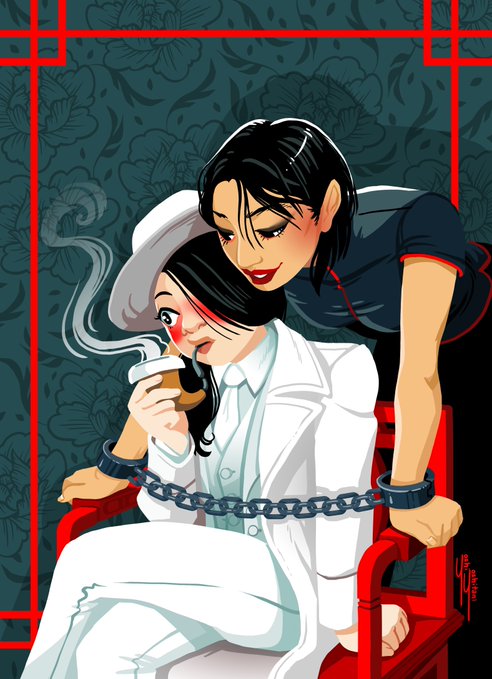
Lastly, here’s a piece of art Paul Krueger himself commissioned from artist Yoshi Yoshitani, of the two character Lee and Xiulan:
 Amanda Haimoto Rudd