Book Review: Atmosphere by Taylor Jenkins Reid

I recently picked up Taylor Jenkins Reid’s new release, Atmosphere (released on June 3rd 2025), and read it in two afternoons. Reid is known for her literary historical fiction with prominent romantic subplots, and her two most recognizable and highly-regarded titles are The Seven Husbands of Evelyn Hugo and Daisy Jones and the Six (which was made into a television mini series). I haven’t read her work before, but I’d seen that her historical settings are generally well-researched and her romances tend toward the sapphic. What sold me on Atmosphere, though, was how uniquely targeted it was to me specifically, almost as if by design. It is about a woman named Joan who is an astronomy professor at Rice University in Houston, who joins the NASA shuttle program in the 1980s and (of course) falls in love with a fellow women astronaut candidate named Vanessa.

Considering that I am a queer woman who lives in Houston, have (briefly) worked on the Rice University campus, was once long-ago a Physics major in college (closely related to astronomy) and I am a massive NASA nerd who has visited Space Center Houston on many occasions… well, this book was basically written FOR ME.

Atmosphere is told primarily from the perspective of astronomer Joan Goodwin, a brilliant accomplished woman who, in addition to her work, takes care of her sister, Barbara, and her niece, Frances (who would suffer from serious neglect without Joan’s presence). Unlike Barbara, who has spent her life flitting from man to man and getting herself into trouble, Joan is serious, self-controlled, and never shown the slightest interest in romance. She doesn’t even particularly like kissing. She has watched her mother’s personality subsumed by her father’s—even despite the fact that they genuinely love each other—and vowed never to let that happen to her. Instead, she devotes her life to her love for astronomy and pursuit of knowledge.

When, in 1980, NASA opens astronaut candidate applications to women for the first time, Joan, who has spent her life dreaming of the stars and believing she would never be able to reach them, leaps at the opportunity. She finds herself among a small group of women accepted into the program. Over the course of two years of training and preparation with her candidate cohort, she befriends many fellow astronauts, and finds herself falling inexorably in love with one, Vanessa Ford, a mechanical engineer and pilot. For the first time in her life, Joan understands what all the fuss is about. However, the two women must be enormously careful, for this is the 1980s, and anything labeled “sexually deviant” could get them both fired from the program.

The novel is told out of sequence. The first chapter opens in 1984, as Vanessa takes her first shuttle flight while Joan works in Mission Control, having already experienced her first flight mission a couple months before. The chapter ends just as an emergency situation on the shuttle places Vanessa and the rest of the crew in serious danger. The novel than jumps back to 1980, when Joan first learns about the new application process. From there, chapters jump back and forth between Joan’s experiences from 1980 through 1983, (as she joins the program, completes her training, and falls in love with Vanessa), and the unfolding catastrophe on the shuttle in 1984 which finds Joan having to talk her lover through a potentially deadly situation without revealing the depth of her feelings to the rest of Mission Control.

The research details of the novel are impeccable. I recognized the locations mentioned around the greater Houston area with an amusing and disorienting sensation (I do not often see books talking about my own neighborhoods). And the details about the NASA shuttle program, the training, the operations in Mission Control, the design of the shuttle and equipment, were all accurate (at least to my amateur enthusiast’s eyes) and helped ground the love story in its time and place. The love story itself unfolds in a slow, careful way that felt organic and lovely. And the character of Joan was complex and real. Even more than her relationship with Vanessa, what sang to me the most was her relationship with her sister and her niece, which grows increasingly fraught as the story progresses. Those moments in particular felt real and important and painful to me. By the time the novel reaches its emotional payout in the end, it feels earned.

This book hit me with surprising force a few different ways. For one thing, I see an uncomfortable amount of myself in Joan. In her relationship with Barbara, the way she bites her tongue to keep the peace and allows her (selfish, manipulative, narcissistic) sister to run roughshod over her life. I too have done that with family far more often than I would like to admit. I also see myself in her fear of inadequacy, in her work, among her peers, and especially within romantic entanglements. She has a hard time believe she’s even allowed to want these things, let alone have them and be good at them. I get that feeling. These are all feelings that I think the book wants people to feel, to identify with, to absorb. And I absolutely did. So job well done.

Somewhat embarrassingly, one of the aspects of the novel the hit me the fastest and the hardest was an element that is probably pretty minor to the average person. The thing that got me crying only 22-23 pages in. The thing that kept me crying for a good chunk of the book. It was the moment Joan got the call that she had been accepted into NASA to begin with. I had to put the book down. I started to sob. I had to talk to my best friend so he could help me calm down.

You see, I wanted to be an astronaut. I know, most children wanted to be an astronaut at some point in their lives. But for me it was a serious goal for a time. The first three years of my undergraduate degree, I was a physics major. I had a plan. I was going to get my physics degree, join the Navy science program, and work my way into NASA. But that didn’t happen. I ended up getting a Bachelor’s and a Master’s degree in Literature, and taught for nearly ten years, and got most of my way through a PhD as well. There were a lot of reasons for that that I won’t dig into here. No one cares about hearing my entire life story, and it’s all rather tangled together.

Suffice to say that despite my love for literature, I look back and regret the decision not to pursue that path to this day. There are times in your life when you stand at a fork in the path, with multiple options. No option is wrong or right, just different, each equally valid in some way, representing some aspect of your personality or your ambition. But each option requires closing down the others forever, no going back and trying again. I made a decision. I often fear it was the wrong one. To this day, I cry every time I watch Apollo 13, or a space documentary, or visit Space Center Houston. And when I read the sentence in Atmosphere, on page 23 when Joan first learns she has been accepted into the training program, I burst into violent sobs. Such is life, I suppose, that we all must live with our choices and swallow our regrets. This novel just happened to stab right at the heart of one of mine.

Atmosphere is not only about two women falling in love, or about the trials and tribulations of the space program. It is about the unfairness of a society that continually and remorselessly dismisses at women, consigning them to the background and scoffing at their ambitions and accomplishments. It is about the long and painful struggle of every woman who has had to kick and scratch and fight to claim a place among men that she has rightfully earned and deserves. It is also about the unfairness and cruelty of a society that forces queer people to hide who they truly are and deny the people they love for the sake of safety. And it is about importance of love and family and true belonging, even if that family ends up not looking like the traditional, idyllic image in a magazine. And its also about the smallness of people and the bigness of the universe, and interconnectedness that encompasses everyone so that even the smallest person’s value rivals that of the whole universe. It’s genuinely, a really beautiful, empathetic, hopeful book.

Book Review: The Last Drop of Hemlock

Title: The Last Drop of Hemlock
Author: Katharine Schellman
Release Date: 6 June 2023
How I Got It: Bought print copy
Rating: 4 Stars

Last year I wrote a review for Katharine Schellman’s book Last Call at the Nightingale, which is a Jazz Age-set historical murder mystery. You can find that first review here. The sequel to that book came out in June, so of course I had to get it. I’ve mentioned before (I think) that Schellman became an instant-buy author for me the minute I read her debut novel, a regency-era mystery called The Body in the Garden, which came out in 2020 and which I wrote about here. I am so happy I found this author. I have loved everything she’s published so far, and this newest book, The Last Drop of Hemlock, is no exception.

The Last Drop of Hemlock picks up a couple months after the end of Nightingale (you will need to read the first book to get some reference and know who all the main players are). Our resident disaster bi (and my personal mascot) Vivian Kelly (Viv) is getting used to her new job working at the Nightingale, the speakeasy owned by the dangerous woman she is dangerously attracted to, Honor. As she did in the first book, Viv quickly finds herself entangled in a murder: this time she has promised to help her best friend Bea find out who murdered her uncle with poisoned whiskey. This investigation leads her to asking for favors from Leo, whom she has indecisively kept at a distance since learning of his deception at the end of the first book. She also has to make deals with mobsters, gets attacked, uncovers a bizarre plot of threats and blackmail, and steals a priceless dress covered in gems.
In the midst of this, she finally convinces her straight-laced sister, Florence, to come to the Nightingale where Honor’s right-hand man, Danny, takes an immediate liking to her and the two begin a (truly sweet and adorable) flirtation. For reasons Viv can hardly explain even to herself this budding relationship makes her strangely jealous. It’s not that she has any designs on Danny for herself. It’s more that she is lonely, stuck and confused by her attractions to both Honor and Leo, and hurt by Honor’s decision to push her away despite acknowledging that the attraction is mutual. So, even though she is happy that her serious sister is having fun, becoming more joyful, she is also afraid of losing her place in Florence’s affections, and she’s jealous that she has not likewise found someone who makes her happy the way Danny seems to make Florence happy.

I would say this installment is not quite as good as the first, which I absolutely adored. But it’s still a ton of fun. The murder mystery in this book doesn’t shock me the way the first one did. The way all the pieces fall together in the end is still very satisfying, but I did actually figure it out ahead of the characters this time, which I did not quite manage in the first book.

As with the first book, the research and attention to historical detail is impeccable. As someone who is trying (and mostly failing) to write a 1920s set historical fiction novel, I know how much work that takes, and I am duly impressed. Schellman really does a great job building the setting with rich detail. This version of Jazz Age New York feels real and lived in. The Nightingale in particular comes to life with technicolor and Dolby surround sound. And even the streets and shops and Chinatown and the various incidental characters that live there all feel real and alive.

There are many things I love about the series in general. First, of course, is Viv. As a disaster bi myself, I have a lot of fellow-feeling for Viv. For her chaotic tendencies, her attractions to two very different but both wildly appealing people, her confusion, her need to get lost in the smoke and the sweat and the music at the speakeasy. This is a character I know and understand. One of the things about this installment was getting to see/learn more of the other supporting characters, especially Bea, Florence, and Danny.

I also really liked some of the small bits of social commentary threaded throughout the plot. As Danny shows Viv and Florence his home in Chinatown, they (and we as the readers) learn more about the way the Chinese immigrant community lived in the 20s, and the kinds of racism and obstacles they had to face when they arrived in New York. These books (both of them, but especially this one) also do not shy away from examining the huge gaps between the wealthy and the working class during this time period. So often, Jazz Age stories focus on the wild lives of the rich, but this book stays with the working class and the poor. The ones living in cheap, rundown tenements, who are struggling to scrape by. And in these spaces we see the ways these working class communities supported each other and helped each other in times of crisis. This is one of the biggest strengths of the book in my opinion.

Was this book on quite the same level as the previous one? No. But that is a common issue with the follow-up to a strong opener. That said, I did still really enjoy it and recommend it. And I am looking forward to the next installment. The ending of the Last Drop of Hemlock does, of course, wrap up the big mystery plot of the novel. But it opens up new possibilities for Viv’s personal/romantic life that I am very excited to return to. I am also interested in seeing how the budding romance between Florence and Danny shakes out. Obviously, I don’t know for certain that there will be a next book, but mystery novels like this tend to be popular in long-series form, and provided this one does well enough it seems a safe bet to assume there will be a follow up.

In the meantime, Murder at Midnight – the next book in Katharine Schellman’s other series, the Lily Adler Mysteries, is due out in September. As I said at the top of this post, the first Lily Adler book was Schellman’s debut and I loved it so much that she became an instant-buy for me based on that single book. The third book in the series came out last year, and while I absolutely enjoyed it, I felt strongly that it suffered from missing Lily Adler’s staunch supporter, Captain Jack Hartley. It seems like he should be back in the next book and I am SO excited for it. Yes, I swoon over this character. So sue me. (Don’t actually sue me, I have no money.) If you read these books you will probably understand. And in all fairness, I’m also swooning over Lily the entire time too. And in the grand tradition of many murder mystery series, this one appears to be a Christmas installment!

So, you will no doubt be getting another Katharine Schellman-centered book review in September.

Book Review: the Monk & Robot Duology

Title: A Psalm for the Wild-Built (Book 1), A Prayer for the Crown-Shy (Book 2)
Author: Becky Chambers
Publication Dates: 2021, 2022
How I Got Them: Bought in print
Rating: 5 stars! 6! 7!

As I try to get myself back into the swing of full book reviews – and I hadn’t meant to go so long without any! I’m still reading plenty, but writing the reviews has proven too much for my brain lately – I wanted to talk about Becky Chambers’ two Monk & Robot novellas. I read them a few months ago, and they now live rent free in my brain forever. Hell, they are hooked into my ribs and refuse to let go. They made me Feel Things ™, and I was not prepared. I’d heard Becky Chambers was good at that, but these were the first of her books I’d read (I also own The Long Way to Small Angry Planet, but haven’t had a chance to read it yet).

Both books take place in a post-industrial, ecologically-rich utopian society called Panga, where centuries before the stories take place, the robots built to serve humans suddenly and mysteriously gained full sentience, put away their tools, and wandered off into the wilderness never to be seen or heard from again. The humans have since learned the error of their ways (in terms of industrialization, ecological destruction, etc), and now live without robots, mostly in balance with their environments, and at peace with each other. It is left up to guesswork and interpretation if this world is meant to be Earth far far in the future, or another world entirely, with many similarities.

In Panga, we meet the nonbinary (they/them) monk, Sibling Dex who, in the throes of a pervasive ennui and feeling of unfulfilled potential, leaves the safety and comfort of their home monastery to become a traveling tea monk. As a tea monk, they administer comfort, advice, and tea to the far-flung towns and villages on the outskirts of human civilization. Dex becomes very good at this, and highly loved and respected by the villages they frequent. Yet after a couple years, they find even this calling unsatisfying. Dex is filled with yearning, for peace or purpose or something they can’t even name. And so, on a whim, they start journeying out into the uncharted, unforgiving wilderness beyond the villages, in search of a centuries-lost monastery they read about in a history book.

On the way, Dex has the shock of their life when they stumble upon a robot, Splendid Speckled Mosscap, who has been sent by agreement with many other robots, to find humans and attempt to understand them, asking them “what do you need?” This is the first interaction between robots and humans since the robots disappeared centuries before.

Dex and Mosscap team up to travel to the lost monastery, engaging in deep philosophical debates along the way and building toward an odd and marvelous friendship.

The second book picks up directly from the ending of the first book, with Dex and Mosscap journeying back into human civilization so that Mosscap can meet with humans in each village and ask them its question: “what do you need?” On this journey, Mosscap faces its own sense of mortality, and realizes that it is changed merely through interaction with humans. Meanwhile, Dex continues to wrestle with their sense of dissatisfaction, lack of purpose, and desire for fulfillment. We also meet Dex’s family, see many, often contradictory, reactions as humans come face to face with a robot, and have more philosophical debates. While the ending of the second book is satisfying, I still find myself hoping for more. There’s been no talk of another novella yet. Perhaps these two are all Becky Chambers intends to say on the matter, but I hope she returns to Dex and Mosscap eventually.

The first book is essentially one long philosophical discussion wrapped in a beautiful package of lush idyllic wilderness, gentle friendship, and warm fragrant tea.

The second book continues that philosophical discussion, but with more interaction with other characters and a few uncomfortable moments as Dex and Mosscap deal with potentially less-tolerant humans. However, both books are gentle and quiet. Not a lot of “Plot” happens. Dex and Mosscap are traveling, but most of the journeying and tension is internal, emotional. The world and characters of these books are diverse and welcoming and comforting and thoughtful, and the questions asked by Dex and by the text are deeply human and complicated.

Dex’s dissatisfaction with their life could, on one level, be criticized as “first world problems.” After all, Dex’s world is utopian: peaceful and comfortable, people’s needs are met, their desires permitted and catered to wherever possible. No one, as far as one can tell, is starving, or being oppressed. What, then, is there to complain about? Nothing, really. Which is part of Dex’s problem, because they feel guilty about feeling unsettled and dissatisfied and unfulfilled. They feel they have no right to their dissatisfaction, but knowing this does not make the feeling go away.

And I think that’s where these books get at the heart of the matter. Mosscap asks the humans: “what do you need?” and most of the humans HAVE NO IDEA. Some of them seem perfectly content with what they have. Some of them simply don’t know how to answer the question. Some can’t even decide what the difference is between a “need” and a “want.” What does one need? What does one want? Are they the same thing?

Dex’s ennui is deeply human and real. A feeling I recognize in myself. They want happiness, but what is happiness? They want purpose, but each time they think they’ve found it it proves fleeting, unfulfilling, illusory. They fear that there is something wrong with them, something broken, so that nothing will ever feel RIGHT, even though everyone else around them seems just fine.

Dex asks:

“Still. Something is missing. Something is off. So, how fucking spoiled am I, then? How fucking broken? What is wrong with me that I can have everything I could ever want and have ever asked for and still wake up in the morning feeling like every day is a slog?”

I know this feeling intimately.

These books made me cry at least half a dozen times.

These books have fingers that dig into my sternum and grasp at the churning maelstrom of feeling beneath.

They don’t provide easy answers, but possibilities. Mosscap offers a wisdom born of nature, of thoughtful reflection and an almost Zen sensibility (Dex is a monk of a made-up “fantasy” religion concerning six gods, but I’d argue that they have a distinctly Buddhist quality to them).

Mosscap offers this particular bit of advice:

“You’re an animal, Sibling Dex. You are not separate or other. You’re an animal. And animals have no purpose. Nothing has a purpose. The world simply is. If you want to do things that are meaningful to others, fine! Good! So do I! But if I wanted to crawl into a cave and watch stalagmites with Frostfrog for the remainder of my days, that would also be both fine and good. You keep asking why your work is not enough, and I don’t know how to answer that, because it is enough to exist in the world and marvel at it. You don’t need to justify that, or earn it. You are allowed to just live. That is all most animals do.”

Similarly, in the second book, Dex states:

“You don’t have to have a reason to be tired. You don’t have to earn rest or comfort. You’re allowed to just be. I say that wherever I go.” They threw a hand toward their wagon, its wooden sides emblazoned with the summer bear. “It’s painted on the side of my home! But I don’t feel like it’s true, for me. I feel like it’s true for everyone else but not me. I feel like I have to do more than that. Like I have a responsibility to do more than that.”

Of course, in our own world, where capitalism rages unchecked and survival is far from assured, we are not “allowed to just live” and we usually do have to work in order to justify our right to exist in the world. Rest has to be earned purely because society has demanded it. But the Monk & Robot books imagine a world where this might no longer be necessary and it’s a beautiful, hopeful thought.

The second book, Prayer for the Crown-Shy, pushes beyond this by suggesting that, perhaps, the answer is in our connections with other people. In our friendships, and loves, and communities. As Dex and Mosscap travel through parts of Panga in the second book, stopping at each village to ask people what they need, the answer (not always explicitly stated, but often implied by their own interactions with people), is EACH OTHER. This is true for Dex as they reconnect with their family, and make possibly romantic connections with someone they meet while traveling. But it is at its most true at the end when, having nearly reached their final destination and inevitable separation, Dex and Mosscap stop where they’re at. Because they’d rather stay together. They find an answer in each other, in their companionship and gentle, complicated, beautiful friendship.

Dex says:

“What if that is enough, for now? What if we’re both trying to answer something much too big before we’ve answered the small thing we should have started with? What if it’s enough to just be…Us.”

Is it enough? I don’t know. In THIS world, possibly not. But what a hopeful, marvelous idea that it someday could be.

Time Travel Narratives: The Time Traveler’s Almanac

Apologies for the delay! Life is life-ing at me pretty hard right now. But here is the next installment in my mini series on time travel narratives. This week I’m talking about a great short story collection. Next week I’ll share a big Recommended Reading/Viewing List to wrap things up.

The Time Traveler’s Almanac is a short story anthology, published in 2013, edited by Ann and Jeff Vandermeer, that collects 65 short fiction pieces as well as 5 nonfiction essays on the subject of time travel.

This collection contains (among much else): an excerpt from HG Wells’s novel, The Time Machine, Ray Bradbury’s famous short story “A Sound of Thunder,” and Connie Willis’s novelette “Fire Watch” – which introduced the time traveling history department of Oxford University which later became the central focus of her novels Doomsday Book, To Say Nothing of the Dog, and Blackout/All Clear. Many well-known and critically acclaimed short stories are featured in this anthology, as well as  a large number of lesser-known works that are unique and entertaining takes on the genre. One of the strengths of this collection is the breadth and diversity of its selections. The short fiction covers a range of authors, time periods, and subject matter including but not limited to: sexuality, ethnicity, immigration and refugee status, love overcoming adversity, and all the usual science fiction trappings of fate, inevitability, and the mind-bending possibilities of time loops and paradoxes.

A couple of my favorites from this anthology include “The Clock That Went Backwards” by Edward Page Mitchell, “The Gernsback Continuum” by William Gibson.

“The Clock That Went Backwards” (which I mentioned briefly in a previous post) is one of the earliest time travel narratives that features a mechanical/scientific means of time travel (rather than a magical/spiritual one). This short story, published in 1881, predates H.G. Well’s The Time Machine by more than 10 years, and was a major stepping stone in the development of time travel narratives as a genre. In this story, the narrator recounts his childhood with his aunt who owned a very old Dutch clock. When the aunt dies, the narrator takes possession of the clock. While in university, one of his professors takes an interest in the clock, and argues that based on Hegel’s concept of Aufhebung, he believes that the sequence of past, present, and future is arbitrary and can be changed. To demonstrate, he winds the Dutch clock backwards, during which it is struck by lightning and causes a fire. In the aftermath the professor and the narrator find themselves thrown out of their time and into the 1500s. After a series of disasters, the narrator is knocked unconscious and awakens back in his own time again. It is never clear how the clock sent them to the past, nor how they returned.
“The Gernsback Continuum” is a short story by William Gibson published in 1981. Gibson, incidentally, is one of my favorite authors and his first novel Neuromancer, is one of the most important cyberpunk novels (arguably the first) ever written. The name “Gernsback” in the title pays homage to Hugo Gernsback, a publisher who pioneered the creation of science fiction pulp magazines. In this short story, a photographer is assigned to photograph the futuristic architecture of the 1930s, a period in time that attempted to imagine what the far utopian future might look like. While doing so, the photographer finds himself slipping in and out of a version of the present/future 1980s, based not on current reality but on the optimism of that 1930s vision. A version of reality filled with utopian visions of flying cars and zeppelins and glittering “raygun gothic” architecture. Eventually, he breaks free from this slippage of reality back to the real 1980s, which he finds horrific, violent, and full of despair.

A couple other stories in the collection I’d recommend are: “If Ever I Should Leave You” by Pamela Sargent, “Himself in Anachron” by Cordwainer Smith, and “Palimpsest” by Charlie Stross. But seriously, the entire collection is worth a deep dive.

This collection of stories is very well curated and organized by the editors, with a wide range of texts, that offers a strong overview of the time travel narrative genre. It is a good place for any reader or scholar to start as they enter into an in-depth examination of the genre. I highly recommend it to anyone looking to branch out, learn more about the history of the genre, or gain a more expansive view of SFF in general.

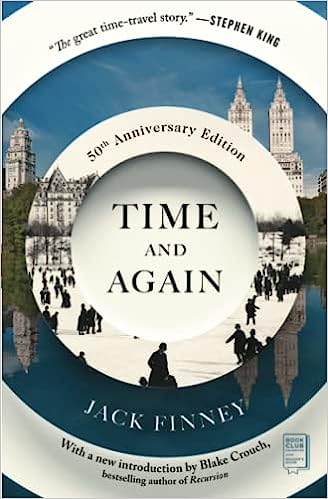
Time Travel Narratives: Time and Again by Jack Finney

I thought briefly that I might write a post about The Time Machine by H.G. Wells, but then I decided that the book (and the many movie versions) are so well-known, and have been discussed by so many smart people, that it would feel a bit redundant for me to do so now. So, I thought I instead that I might talk about a book or two that, while very well-regarded in their time, have not remained as instantly-recognizable with current readers as they should be. And I’m starting with this one: Time and Again by Jack Finney.

I recently had the opportunity to re-read this classic of time travel fiction, which I had read a couple decades ago but didn’t remember much about. I wanted to share a bit about this truly excellent novel, and hopefully encourage more people to read it now.

Time and Again (1970), an illustrated science fiction time travel novel by American author Jack Finney, follows Simon “Si” Morley as he is recruited to a secret government time travel project, and succeeds in traveling to 1882. There, Si tries to unravel a possible conspiracy, falls in love, and faces difficult choices between love and obligation, loyalty and ethical duty. This is the first of two novels, with the sequel From Time to Time (1995) published the year Jack Finney died. Finney left the ending open for a third novel that was never written.

Many of Jack Finney’s short stories and novels had commercial and critical success. His first novel, 5 Against the House, was published in 1954 and made into a movie in 1955. He is most famous for his second novel, The Body Snatchers (1955), which became his most commercially successful venture, spawning the 1956 movie Invasion of the Body Snatchers and its many remakes. Five of Finney’s novels and several short stories were adapted for film and television in his lifetime. However, his greatest critical success came with Time and Again, which remains his most highly-regarded work by fans and critics alike.

In the introduction to the 50th Anniversary edition of Time and Again, science fiction author Blake Crouch credits Jack Finney and this novel with starting him on the path to becoming a best-selling science fiction writer. And Stephen King, in the Afterword for his novel 11/22/63, claims it is “in this writer’s humble opinion, the great time-travel story.”

In Time and Again, the main character, Si Morley, works as an illustrator for an advertising agency in 1970s New York City, where he is dissatisfied with his life, and bored at work, with no family and a few lackluster romantic relationships. One day he receives a visitor at work, a man named “Rube” Prien–a Major in the Army, who has come to recruit Si to a top-secret government project: an experiment in time travel devised by Dr. E. E. Danziger.

Danziger, a physicist, believes he has devised a method of time travel: by tricking the brain into believing a person is already in a physical location in the past, one can become detached from their own time, and travel back in time.

Si is skeptical at first, but ultimately agrees to join the experiment if he is permitted to travel to New York in January 1882, to witness the mailing of a letter and unravel a mystery that has been haunting him and his girlfriend, Kate. Kate’s father gave her a letter once mailed to HIS father, Andrew Carmody in January 1882 – a letter that hints at a fire that may destroy the world, and was somehow connected to Carmody’s suicide years later. Si intends to learn who sent that letter and what it really means.

And so Si’s adventures in time travel begin. He travels back and forth between 1882 and the 1970s several times, uncovering a larger mystery than he could have guessed, and accidentally falling in love in the process. In his efforts to solve the mystery of the letter, he will come face to face with complex ethical questions about the limits of scientific discovery, the moral obligations of those in power, the dangers of messing with the timeline, the inevitability of fate, and what it means to find the place where you belong.

This book is widely considered a masterpiece of the time travel narrative genre. It features rich detailed descriptions of New York City in the 1880s that beautifully make the time period and setting come alive. This is aided by Finney’s meticulous use of real drawings and photographs from the time period (which he attributes to his fictitious characters), and even quotes and clippings from newspapers of the time. The characters are complex, with deep emotional resonance, genuine motivations, and rich histories. Finney treats even many of the briefly-mentioned side characters with careful attention and detail.

In addition, the narrative voice of Si Morley (the story being written in first person POV) as Morley relaying his experiences, is intelligent, wry, and humorous. Si’s sarcastic wit is often on display, both in his descriptions and in his dialogue with other characters. And his observations about humanity are thought-provoking and insightful.

Over fifty years later, Time and Again is still as impressive as it was upon its initial release. Despite a few outdated statements, it continues to be philosophically rigorous, utterly fascinating, beautifully written, and highly entertaining. I strongly believe it will remain a high benchmark for the genre for decades to come.

Series Review: Jackaby Series

[AN: sorry for the delay. I had this post all ready to go, and then I forgot to schedule it! Lol!]

A couple weeks ago, in my post about my recent Victorian historical fiction reading binge, I mentioned that I had read a book called Jackaby by William Ritter. Well, I’ve now finished the series (4 books), and thought I’d share a full series review.

I will try to avoid too many MAJOR spoilers, but as I am talking about the series as a whole there will probably be some.

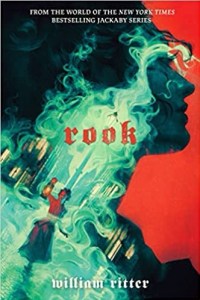
As mentioned, the author is William Ritter (who has also written some middle-grade fiction that looks really great so I’ll probably check those out at some point!). I don’t believe the series as a whole has a name, but the four books are: Jackaby, Beastly Bones, Ghostly Echoes, and Dire King. There is a fifth standalone book coming out in August, called Rook, that I am very much looking forward to. But don’t go looking for the description of that book or you will run face-first into a couple major spoilers for the ending of book 4 (yes this happened to me).

The books take place in a Victorian-age New England city called New Fiddleham (cleverly avoiding any actual states or real cities/geographies). The main characters are Abigail Rook, an intelligent young woman who has recently run away from her home in England in search of adventure, and R.F. Jackaby, a paranormal investigator who becomes her employer. Each book is written in first-person from Abigail’s POV, in a style similar to John Watson reporting about the cases he worked on with Sherlock Holmes — including some amusing little nods to the trope throughout.

R.F. Jackaby is a Seer. In fact, he is THE Seer, as there is only one alive at any given moment. He has the capacity to see the supernatural elements of the world that are mostly invisible to or ignored by the human public. He uses this ability as an investigator in New Fiddleham, dealing with magical and unexplained issues while constantly butting heads with the police chief and the mayor. He lives in a house once owned by a woman who was murdered ten years ago and simply never left — he and the ghost are rather good friends, thankfully.

Abigail Rook is a smart, headstrong young woman who wanted to be an archeologist. Throughout the series she proves herself to be brave and capable and quite often the voice of reason when situations become dire. Her bravery is established pretty early on in her employment with Jackaby when she discovers that his last assistant was turned into a duck, and doesn’t immediately go running and screaming out of the house. Never mind the ghost!

In the first book, Jackaby, the world-building is established and Abigail and Jackaby solve a series of murders, as one does. They also befriend one of the cops, on whom Abigail develops a crush.

In the second book, Beastly Bones, Abigail is given an opportunity to stretch her archeology muscles a bit on a case out in the valley away from the city. The cop Abigail has a crush on, Charlie Barker, has been transferred out to the valley as well, allowing their flirtation to continue with growing adorable-ness (and Jackaby’s hilarious pleas that Abigail not rely on him for emotional or relationship advice). This book gets rather bloody in places, and the mystery of who is doing what to whom was fairly intricate.

[SPOILER BELOW]

There’s a freaking dragon involved! Sort of! It’s complicated!

[SPOILER ENDED]

The second book begins to hint at a larger conspiracy or plot hiding beneath the recent cases that Jackaby and Abigail have worked on. This is fleshed out more in the third book, Ghostly Echoes.

In Ghostly Echoes, Jackaby and Abigail are “hired” by their ghost friend, Jenny, to find out who murdered her. Unfortunately, what should be a relatively straightforward task for them becomes more and more complicated as the clues to Jenny’s murder ten years ago leads them all into the heart of a much larger, deadly plot. This book features a very-polite (but still deadly) vampire, a mad scientist, and a trip on the River Styx into death. And that’s not nearly a lot of it!

Where the first two books were fun jaunts into the murder mystery genre with some paranormal shenanigans thrown in, the third book leaps headfirst into Celtic folklore and epic fantasy. The fourth book, Dire King, then proceeds to shatter the quiet facade of the Victorian city and break into all-out magical war.

The fourth book was so tense and so action-packed I felt like I barely breathed through the entire thing! Despite a couple spoilers I had accidentally run into (while looking at the new book coming out in August), I did not actually know where the book was going for most of it. It goes heavy on the drama, in the best ways possible. I especially appreciated the way Abigail becomes the voice not only of reason but of mercy and goodness and “humanity at its best” throughout the fourth book. And the ending was so SO satisfying. (And there! I managed not to spoil any of the real major bits!)

One of the many things I liked about these books was the relationships. For one, I fully expected it to become a romance between Abigail and Jackaby, just because that tends to be the way these things go (not a complaint! I would have been fine with that as well!). But Ritter defied my expectations by pairing Abigail with the sweet cop, Charlie. (Was there a bit of copaganda, yeah, sure… but it’s such a standard character type in historical fiction and we all know it’s a fantasy anyway, so it didn’t really bother me.)

Another thing I really loved about these books was the absolutely impressive amount of research into folklore and mythology that Ritter had to have done to write these. There are dozens and dozens of references to so many creatures from folklore and mythology it almost boggles the mind! And not just the standard Western ones, though Celtic mythology gets the main focus in the last two books, but also Asian and African as well.

A third of the many things I loved about these books was how truly FUNNY they were. The plots are dark, there’s murder, there’s an attempt to conquer the world in the last book, but despite this (or even because of it) there is a wonderful humor that threads its way through the entire series. Jackaby is deadpan and drily sarcastic (one of my favorite character types), and the interactions between Jackaby and Abigail are one of the major highlights of the whole series.

The whole series was a delight from start to finish. I thoroughly enjoyed all four books, but especially the last one. I cannot wait to read the new one, Rook, coming out in August. What’s even better is that the whole series is getting a reprint in August. I read the books by borrowing the ebooks from the library. And there are ebook and print versions available on Amazon. I think they were self-published, or perhaps indie-published by a small press. But either way, they are getting a new printing with brand new cover art at the same time as the release of the fifth book.

Ironically enough, it was the new cover art that first got me to read these. I follow the artist doing the new covers, Corey Brickley, online. I love his work (seriously go check him out!). He posted the cover reveal for Jackaby with his new artwork and a brief description of the book and I knew it would be right up my alley (I mean! Compare the cover at the top of the post, with the rest of the covers in the post!). But I probably would not have ever run across them if Corey Brickley had not been commissioned to do new covers! It’s so funny how the world works sometimes…

Anyway, I highly recommend these books. As mentioned, they are available to purchase right now in ebook or paperback. Or you can do like I did, and borrow them from the library so that you can buy the NEW covers in August without ending up with two whole sets.

My Month of Victorian Romances

Sometimes I get in these moods, where I read one particular kind of book and just CANNOT STOP reading that particular kind of book. I go through cycles where I absolutely devour certain genres or sub-genres. Back in 2020 I went through a huge space opera phase. In mid-2021 there was a big period of murder mysteries. My romance reading in general tends to happen in big chunks.

Starting around the beginning of December, and going through Christmas and New Years, and the first couple weeks of January, I’ve been voraciously consuming historical romance novels set in the Victorian time period. Within that there have been a few variations: a few straight romances, a few mystery types, a few fantasy types. But all of them have been Victorian historical fiction.

In order, I have now read:
Soulless by Gail Carriger
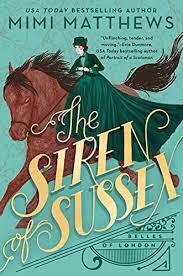
The Siren of Sussex by Mimi Matthews
A Lady’s Guide to Mischief and Mayhem by Manda Collins
An Heiress’s Guide to Deception and Desire by Manda Collins
The Belle of Belgrave Square by Mimi Matthews
Widdershins by Jordan L. Hawk (a re-read by still in the same Victorian-set genre)
Changeless by Gail Carriger (started by didn’t finish)
Jackaby by William Ritter
Beastly Bones by William Ritter

Soulless and Changeless are the first two books of Gail Carriger’s Parasol Protectorate series (paranormal romance/steampunk set in Victorian England). I read Carriger’s YA The Finishing School series last year. I didn’t realize until after the fact that the Parasol Protectorate series was an adult series, and written first, and the Finishing School series is a prequel. But I enjoyed the YA books enough to try out the adult series. I wouldn’t say I loved the Finishing School books, but I enjoyed them. They were silly and frothy and adventurous and fun. I found Soulless for cheap at the used bookstore and enjoyed it enough, and then I grabbed the sequel, Changeless, at the library. I won’t say it’s a DNF. I think I might come back to it eventually, probably. But some of the characters that I knew from the Finishing School series appear in ways I really didn’t like (again, I realize the Parasol books came first, so it’s my own fault, but however it happened, I am far more attached to the version of the characters from the prequel series and I was pretty upset about some things in Changeless, which I won’t specify as they are spoilery). Changeless, also frankly was not scratching the particular ITCH I had when I jumped into these Victorian books. So I returned it to the library early.

The Belles of London series encompasses the books The Siren of Sussex and The Belle of Belgrave Square by Mimi Matthews (and a third one is coming out in 2024). These were straight Victorian romance – no magic or murder mysteries in these, just lots of Victorian-period melodrama, which I loved. I loved them so much that The Siren of Sussex made it onto my favorite books of the year list! They are swoony and fun and filled with smart, interesting, complex women and honorable men trying to do the right thing under difficult circumstances, and all the kinds of societal roadblocks and miscommunication issues one might expect from the genre. They are not out to defy the genre expectations, but rather play them up to great effect. I am really looking forward to the third one.

In what appears to be very much a pattern in these kinds of novels, the two books by Manda Collins, A Lady’s Guide to Mischief and Mayhem, and An Heiress’s Guide to Deception and Desire are also linked books, with at least one more book to be released in the series this year in March. These are historical romance/mystery hybrids (one of my favorite combos!), with each book featuring a woman MC solving a crime while also following in love with the charming man helping them investigate. They are both really great mysteries (I had the first one figured out about ⅔ of the way through but the second one kept me guessing until right near the end). And the romances are both sweet and swoony. The first one is a rivals-to-lovers pairing (a police detective and a woman who’s doing her own investigating and keeps messing with his career). The second book is a second-chance romance with a pair of lovers who broke off their engagement years ago, mixed with a marriage of convenience (it’s complicated!). I really loved both and I cannot wait for the third one!

Finally, I have an already completed series of four books by William Ritter that are Victorian-age historical paranormal mysteries. They are not romance, strictly-speaking, though there is a romantic subplot threaded through all the books. They are about a woman from England who comes to America and finds employment with a paranormal investigator. The books are written in first person with the woman, Abigail, narrating her adventures with the investigator, Jackaby, in a way similar to Watson’s narration of the Sherlock Holmes stories. I have finished the first two books, and already have the third one checked out from the library and ready to go. These books are BLAST. Fun mystery writing, lots of period-appropriate set dressing and some really fun paranormal monsters including the usuals such as werewolves, vampires, ghosts, as well as some things you would not expect. I can’t wait to see where these go next!

So that’s what my reading has looked like the last month or so (about a month and a half now, actually, I guess). I think I’m going to finish the William Ritter series now, and then I’m thinking I might jump into something different. I’m thinking about getting back into big epic fantasy tomes. I used to read them almost exclusively in high school. Big giant 800-page types. But I fell out of the habit in college and then grad school killed my reading altogether (as I’ve talked about on this blog before), and since I’ve gotten back into the swing of things I haven’t really returned to my roots yet. I think it’s about time. But we’ll see…

Anticipated New Book Releases (Jan-Feb 2023)

Hello all and happy new year! I thought I would kick-off the first week of the year with a brief list of some of my own personally Most-Anticipated Books for the start of 2023. I keep a pretty extensive list throughout the year, but because my time and my budget is very finite, I usually only end up reading a very small fraction of all the new releases that catch my attention. I won’t share the whole current list here, but I will share a few of the books that are releasing January and February of this year that I am excited about, and which you folks might find interesting as well.

(A few notes: I have these listed in release date order, and I include title, author, release date, genre, and publisher. Most of them are fantasy/SF because that’s mostly what I read, but there are some other things mixed in. I would also like to point out that anything from HarperCollins, while I am excited about them, I will probably not actually buy and/or review until the strike is resolved.)

JANUARY RELEASES:

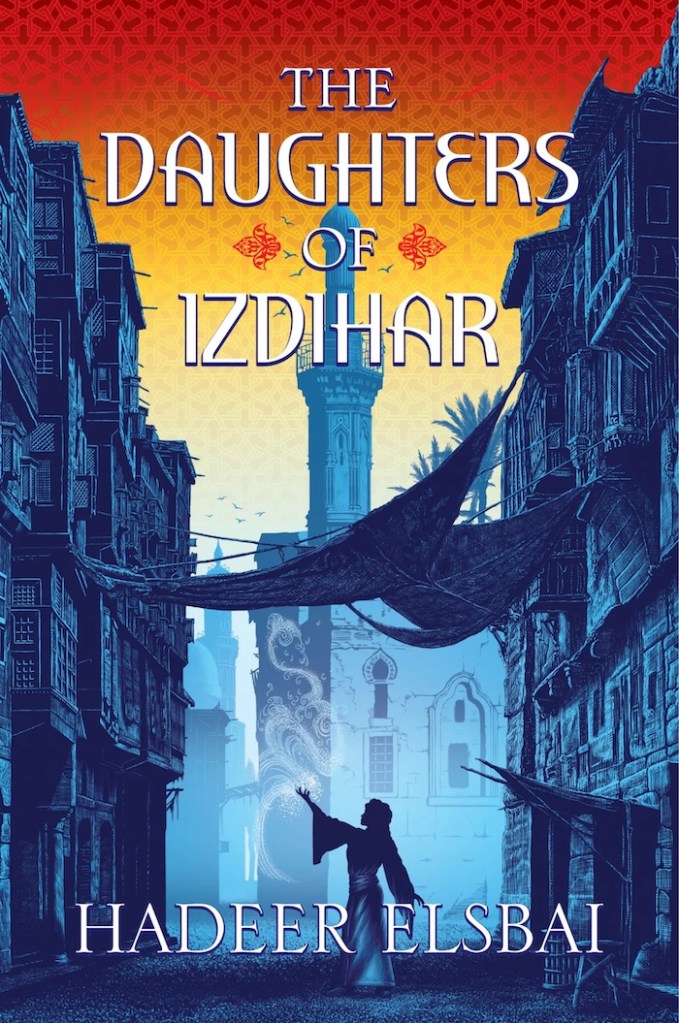
The Daughters of Izdihar by Hadeer Elsbai: releases Jan 10 (HarperCollins), this is an Egyptian-inspired fantasy, with a sapphic romantic subplot, and I am so excited for this one. It doesn’t hurt that the cover is absolutely gorgeous.

Phaedra by Laura Shepperson: releases Jan 10 (Penguin Random House), this one is a feminist retelling of the Greek myth of Phaedra, the sister of the Minotaur. This one is, by all accounts, unflinching and incisive. And I love me a good feminist retelling.

The Written World and the Unwritten World by Italo Calvino: releases Jan 17 (HarperCollins), this is a nonfiction collection of essays by the brilliant amazing incomparable Italo Calvino that will discuss his thoughts on literature and writing. Italo Calvino, author of such masterpieces as Invisible Cities (1972) and If on a winter’s night a traveler (1979), is one of my favorites and I am elated to have this previously-untranslated collection coming out!

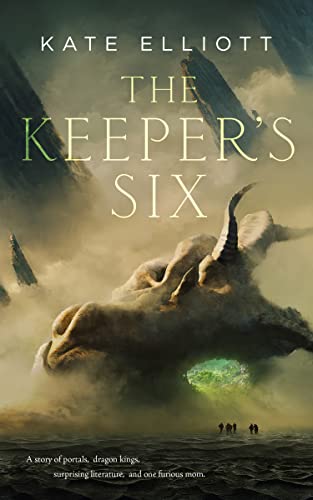
Keeper’s Six by Kate Elliott: releases Jan 17 (Macmillan), this short fantasy novel features a bad-ass world-hopping mother who gets her old adventuring group back together to rescue her adult son who has been kidnapped by an old enemy. Kate Elliott has been a big name in SFF for years, but I only really got to know her work with Unconquerable Sun in 2020. However, I have since then become a devotee, and will buy anything she cares to release.

Everyone in My Family Has Killed Someone by Benjamin Stevenson: releases Jan 17 (HarperCollins), this one is a new murdery mystery about a man who writes mystery-writing how-to books and is an expert in golden age mystery novels, who must put all his knowledge to the test when he goes to a ski resort for a family reunion and everyone starts dying around him. This one just sounds like a ton of fun, and I love the prospect of a modern mystery that incorporates send-ups to the golden age (if you loved the movies Knives Out and Glass Onion you will probably like this book).

The Terraformers by Annalee Newitz: releases Jan 31 (Macmillan), Annalee Newitz is a phenomenal sf writer, who imagines some really fascinating near-future and far-future versions of the world. This new book from her will look at terraforming, eco-systems, and our hopes for the future. I’m really looking forward to this one.

FEBRUARY RELEASES:

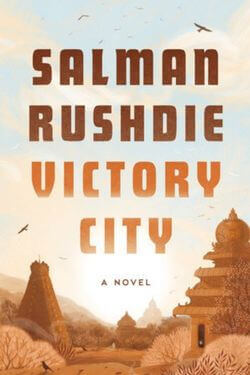
Victory City by Salman Rushdie: releases Feb 7 (Penguin Random House), so, I mean, it’s SALMAN RUSHDIE, do you even need to know more than that? As with all his works, Victory City is historical fantasy/magical realism. It will, no doubt, be about India, and history, and the world, and the future, and everything in between. It’s about a woman who creates her own personal empire with the force of her imagination.

The Last Tale of the Flower Bride by Roshani Chokshi: releases Feb 14 (HarperCollins), this is the adult fantasy debut from a loved and respected YA writer. This book is a gothic romantic fantasy/fairy tale about a marriage falling apart among the secrets of the past.

Arch-Conspirator by Veronica Roth: releases Feb 21 (Macmillan), Veronica Roth has been on my TBR list for ages, and I still have not gotten around to picking up any of her work. But this book might finally change that because it sounds amazing. It’s a dystopic science fiction retelling of the Greek tragedy Antigone. If that doesn’t grab your attention, I don’t know what to do with you.

The Magician’s Daughter by H.G. Parry: releases Feb 21 (Hachette), I first heard about this book about a year ago when an author I follow on Twitter was talking about reading an early ARC, and it just sounds precisely to my taste. It’s a historical fantasy romance about an orphan from a secret magical island off the coast of Ireland, who must come to London to protect her home and her guardian. I am so stoked for this one!

Enchantment: Awakening to Wonder in an Anxious Age by Katherine May: releases 28 Feb (Penguin Random House), this nonfiction book from the author of Wintering: The Power of Rest and Retreat in Difficult Times, is pretty much exactly what the title says it is. It discusses the anxiety, fatigue, and trauma of our times, and looks to the beauty and wonder of the natural world for its restorative power.

The Crane Husband by Kelly Barnhill: releases Feb 28 (Macmillan), this novella, from the author of The Girl Who Drank the Moon, is a dark horror/fantasy re-imagining of the old Japanese folktale “The Crane Wife.” I did mention I love myth/fairytale retellings, right? And it’s a Japanese folktale! Call me sold!

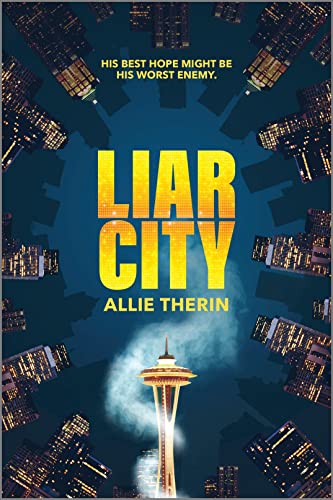
Liar City by Allie Therin: releases Feb 28 (Carina Press), I wrote before on this blog about Allie Therin’s previous work, The Magic in Manhattan trilogy — a 1920s-set historical fantasy romance that I am ABSOLUTELY ENAMORED with. This is something of a different take than her previous work, taking place in contemporary Seattle, with an empath who works a police consultant and is pulled into a case with the FBI. At this point I will buy anything Allie Therin sells me. Hell, I’d probably follow her to Mount Doom if she asked me.

My Fave Reads of the Year, 2022 Edition

Hello all and welcome to the last Friday of the year! I hope everyone had a wonderful holiday week last week, and that you are excited for the new year and all the possibilities that might bring. The last year, or two years really, have been pretty rough, and I am really hoping that 2023 will be a bit kinder to us all. But I am… skeptical, let’s say. Still, I am trying to approach the new year with a feeling of cautious optimism. We shall see how it goes.

Before I jump into my fave reads list, I have several things in the works I want to mention. I have officially started my work as a freelance editor. And I am preparing to launch an etsy shop to sell the fluid paintings I’ve been making off-and-on for the last couple months. The first handful were all gifts to various family and friends, but I have a bunch now that are piling up in my office, so I’m hoping to sell them for just a bit – enough to clear out the space in my office and buy supplies so I can make some more. I’ll have the shop linked here probably in the first week of January for the curious.

I am also considering changing the name of the blog… though, I am still on the fence about that. As I mentioned in my About page ages ago, I chose the name “Night Forest Books” as the name of my hypothetical future bookstore. I’ve had the name in mind since AT LEAST 2016. It’s a reference to my favorite book, The Neverending Story, and the location called “Perilin, the Night Forest.” When I first chose the name I did a lot of research to make sure no other bookstore or related business had claimed the name already. I bought the .com domain for future use, and I claimed the IG name (@night.forest.books) and this blog title. However, I was nowhere near ready to actually register a business or LLC name as I knew it would be probably years before I was financially ready to start the bookstore.

Well, apparently in mid-2020 a brand new micro-press started in CANADA, and they named themselves Night Forest Press. Obviously, even if they did research on the name, they did not consider my teeny-tiny blog a problem, whether it had essentially the same name or not, and since I didn’t have an actual business registered under that name it was legally up for grabs. I could probably still get away with naming a bookstore Night Forest Books if I really wanted to (maybe, I’m not certain), but googling “Night Forest Books” right now just brings up the press website. And I had vague ambitions of maybe someday starting a press associated with the hypothetical bookstore, which would no longer be a viable option under the current name. So, I will need to find a new name for the hypothetical bookstore…

Of course, the blog name is still fine right now. However, as I said, googling for “Night Forest Books” right now does not remotely lead to my blog, which is really disheartening. Besides which, my initial thought was that the blog would be a good way to establish some recognition among readership in advance of opening the bookstore, and if the bookstore has an entirely different name from the blog that kind of defeats the purpose…

So… yeah… I’m on the fence about changing the blog name, or just letting it be and worrying about the bookstore name later. Maybe I’ll just go back to using my actual name for the blog for the time being. That might at least make it obvious in search engines again… maybe. *shrug* If anyone has any thoughts, please feel free to share.

OKAY! And now the thing I’m supposed to actually be writing about today. My Favorite Reads of 2022 List!

I had a really difficult time narrowing the list down this year. (Well, ok, every year). What I have ended up with is a list of 10 books. My top 5 favorite new release fiction books, released in the calendar year of 2022, plus my top 5 favorite nonfiction books, none of which were new releases for 2022 but which were all new reads for me.

My Top 5 Fiction New Releases:

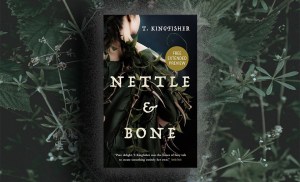
Nettle & Bone by T. Kingfisher: This book by the masterful T. Kingfisher (Ursula Vernon) is a beautiful dark fairy tale with prose that makes me weep with awe and jealousy. I wrote a full review for Nettle & Bone way back at the beginning of the year, where I predicted that it might end up being my favorite book of the year when it was all said and done, though I conceded that Nona the Ninth might easily change my mind when it was released. But lo and behold! I stand by my initial statement! I absolutely adored this book and it remains my favorite book of the year.

A Restless Truth by Freya Marske: you can find the full review of this one and the first book in the trilogy just a few weeks back. This one is a historical romance fantasy set in Edwardian England, featuring a murder mystery, lots of magic, and some very steamy sex. I loved it (and the first one, A Marvellous Light), and I’ve already re-read it once since finishing it.

Nona the Ninth by Tamsyn Muir: I know I still owe you all an actual review of this one, oops… For those still in the dark (how?) this book (and series) is a mind-bending, genre-busting, space opera mixed with necromantic magic, and one of the most complex examinations of love in all its forms (including toxic and self-destructive) that I have ever read. I’ll admit that I fully expected this one to overtake Nettle & Bone as my favorite, but though I loved it immensely, it ended up slipping down to third place. Nona the Ninth, the third of the Locked Tomb series, was excellent, and mind-boggling, but of the three it is my least favorite. Nona was a delight of a character, but the first book is still by far the most FUN. So far I love them in order, lol (Gideon, then Harrow, then Nona).

Last Call at the Nightingale by Katherine Schellman: here’s another one I read and reviewed pretty early in the year! It’s a historical murder mystery novel set in the 1920s, which is of course a good portion of what I love about it. And it features a disaster bi protagonist that I relate to rather strongly, lol! I read the whole thing in one sitting, just absolutely DEVOURED it. I fervently await the sequel!

The Siren of Sussex by Mimi Matthews: I have not written a full review for this one yet, but I might try to put one together for it and its sequel later. This one is straight romance novel material, historical (Victorian setting), and absolutely lovely! I read it about a month ago and I am currently in a big Victorian-set historical romance brainrot mode. I also read the sequel to this one, The Belle of Belgrave Square. There will be a third one apparently sometime next year, so maybe I’ll do a double review for books 1 and 2 in time for the 3rd release. This book just really made me happy, with a headstrong intelligent female lead and a Indian-immigrant working-class love interest, and lots of witty banter.

My Top 5 Nonfiction Books:

Zen and the Art of Saving the Planet by Thich Nhat Hanh: this is the last book that came out before Thich Nhat Hanh’s death in 2021. If you are unfamiliar with him, he was a very famous well-respected Buddhist monk who wrote many books on Buddhist, meditation, and finding peace in your own life. He gave lectures, met with world leaders, ran retreats, and generally just made the world a better place by his existence. He was/is one of the greatest heroes in my life, and I was absolutely DISTRAUGHT when he died last year. (And, shit, I am genuinely getting choked up just typing this.) This book is kind of exactly what the title suggests: a way of approaching the crises of our planet (ecological, political, systemic, personal) from a Buddhist perspective but also from a largely non-denominational place of deeply human spirituality and compassion. It made me cry at least three or four times, and the minute I finished it I threatened to buy a copy for every person I know to make them read it (if I’d had the funds, I really probably would have).

Make Your Art No Matter What by Beth Pickens: I have a soft-spot for self-improvement books, but more specifically I really love self-improvement books about living an authentic and creative life. For instance, I also liked Big Magic by Elizabeth Gilbert (though I do find Gilbert a little too woo-woo and mystical hand-wavy at times). This book by Beth Pickens is about living life as an artist — and she defines “artist” very broadly — and offers real concrete advice on how to live that life to the best of your ability and with the most fulfillment you can manage, whether you are a full-time professional artist or someone trying to eke out a practice around a day job and family and other responsibilities. I found it incredibly insightful, down-to-earth, actionable, and really inspiring.

The Dragon Behind the Glass by Emily Voigt: I really love nonfiction books about history or science, and this one is kind of both. I picked it up on a whim and found it absolutely fascinating. It’s about the exotic fish trade, of all things! Specifically about a rare exotic fish called an arawona, which is allegedly the most expensive kind of collector/live fish in the world (most expensive fish of any kind in the world are, I think, some of the giant tuna caught/killed in Asia and sold by auction to high-end restaurants for sometimes millions of dollars). This book, and the exotic fish trade, includes: trips into the deepest barely-explored jungles of Asia and South America, run-ins with the black market and the mob, and devolves into fraud, betrayal, and even murder. It’s absolutely shocking and enormously fascinating!

1920: The Year That Made the Decade Roar by Eric Burns: I think I’ve mentioned before I am a bit obsessed with the 1920s Jazz Age era? So I assume no one is surprised that I picked up this book. It is pretty much exactly what it says it is: its a history book that focused on JUST the single year of 1920, and makes an argument that the events of that single year was the catalyst and predictor for everything that came after it. One of the major events the book focuses on is the 1920 Wall Street bombing, which remained the most destructive incident of domestic terrorism until the Oklahoma City bombing in 1995. (I found that section SO interesting that the Wall Street bombing eventually became the instigating event for the plot in my 1920s historical fiction work-in-progress). The whole book was really enlightening and I highly recommend it to anyone interested in American history.

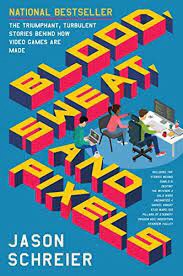
Blood, Sweat, and Pixels by Jason Schreier: the subtitle for this book is “The triumphant, turbulent stories behind how video games are made.” It’s a really well-researched account written by a games journalist about the game industry, using an enormous amount of first-persons accounts and interviews. Each chapter focuses on the story of a different game, including (but not limited to) Witcher 3, Uncharted 4, Dragon Age: Inquisition, and Stardew Valley. I’m not even a big gamer (just a dabbler), so I’m not 100% sure why I decided to pick this one to begin with, but I’m so glad I did! It was so cool to learn about how these games are developed and the kind of crazy sheningans that happen behind the scenes. (The dude who made Stardew Valley continues to blow my mind.) It’s also really fun now to watch the comedy tv show Mythic Quest on Apple+ and constantly go “that’s not how that works! That’s not how any of that works!” Lol…

So, that’s my list, for whatever it’s worth. I’d love to hear what books you read and loved this year! Please feel free to share in the comments!

Christmas Week!

Hello folks! This is just a quick heads-up to let you all know that I will not have a full blog post up this Friday, as it is Christmas Week and I have family stuff, etc. I plan to have my “Fave Reads of the Year” list up the following Friday (last Friday of the year!). I have a long list worked out, but I am having a very difficult time cutting it down, lol! This is always my problem with all sorts of “best of” lists. I love too many things and I hate trying to prioritize, put in numerical order, or cut down, so we’ll see how it goes…

Also: I have a couple of upcoming-release books I plan to review. HOWEVER, they are both HarperCollins books, and I am waiting to post reviews of these books until the current HarperCollins strike is resolved. While this does impact the authors, most of the affected authors have voiced enthusiastic support for the striking HarperCollins union. They have encouraged book reviewers NOT to cross the virtual picket line, and to withhold reviews until further notice.

If you are unfamiliar with the HarperCollins Union strike, here’s a decent and brief run-down of what’s going on from The Washington Post: https://www.msn.com/en-us/news/us/harpercollins-staffers-are-striking-here-e2-80-99s-why-that-matters-to-readers/ar-AA15i38K

For discussion of the strike from the Union itself, there are these two press releases:

Initial Press Release, Oct 17th

Updated Press Release, Dec 7th

I also highly recommend following the Strike account on Twitter: @/hcpunion for all updates, and links to ways you can support the strike.

Ok, that’s all from me for now! Merry Christmas to those who celebrate! Happy Chanukah to my friends in the Jewish community! And a general happy week to everyone, religious or not! See you all after Christmas!