Book: Solutions and Other Problems Author: Allie Brosh Release Date: September 2020 Source: own Rating: 4 out of 5 stars
If you’re familiar with the name Allie Brosh, you know where this is going. Allie Brosh maintained a blog called Hyperbole and a Half, which was half personal essay, half comic (drawn with child-like simplicity). The blog discussed her rather unusual childhood, her struggles with severe depression, and her very silly dog. It was at turns hilarious, heartfelt, sobering, and very very recognizable to those of us who also deal with severe depression.
In October 2013, her first book was published, also titled Hyperbole and a Half, which contains some essays/comics from her blog, as well as new material. It did very well. She went on book tours and all that. And then she disappeared, seemingly off the face of the planet, for seven years.
When Simon & Schuster announced the imminent release of her new book (I think I first heard about it no sooner than July of this year), it was a SHOCK! There had been no news of Allie Brosh for AGES. I had wondered often how she was doing, and if she had perhaps lost her battle with depression and suicide ideation after all. And suddenly here she was again! I was ecstatic! And I still am.
Her new book, titled Solutions and Other Problems, covers a lot of ground. It covers the reasons for her long disappearance, including severe physical health issues (she nearly died!), a divorce, and the death of her sister. It also covers, in far more detail than her first book, how truly strange she was as a child (and still is!). Just like her first book, and the blog before it, it is both hilarious and sobering. And heartbreaking. I laugh so hard during the first few chapters I could barely breathe. A few chapters later, and I was crying.
The simplistic child-like drawing style is the same, and her characteristic wit and humor are still there, but this book is angrier and sadder than her first book. And for good reason, as you’ll see if you read it.
And yet, it is still laugh-out-loud hilarious. I’m not sure how she manages to hold these conflicting tones and feelings in balance, but she does. Constantly. I suspect it is how she lives her whole life, and is probably the only way she has managed to survive as long as she has.
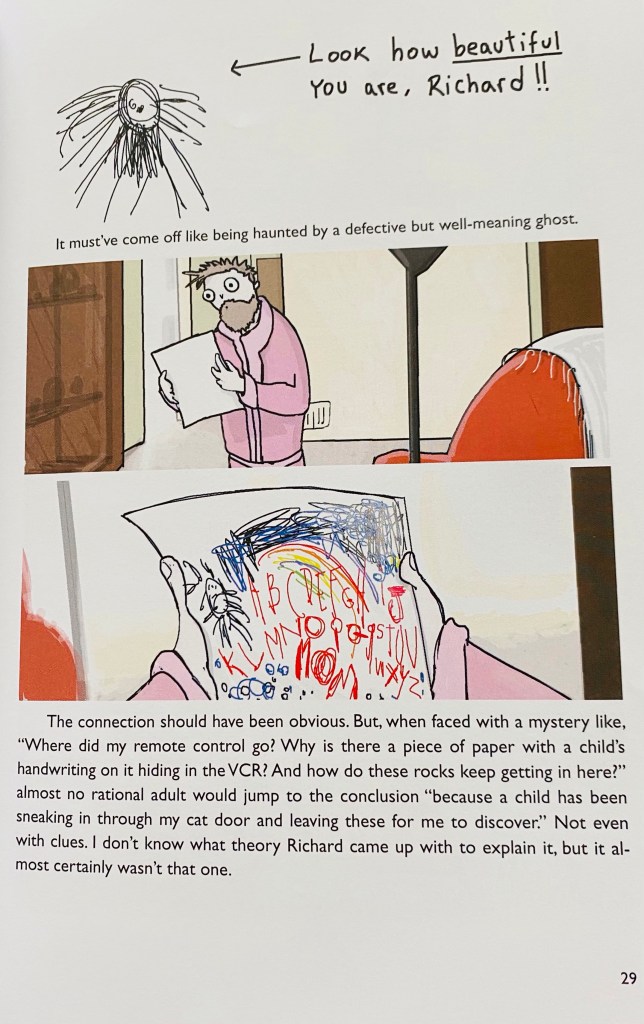
Now, to help you understand the true hilarity and insanity of this book, I would like to share just a bit of the second chapter. In this chapter, Allie Brosh explains how she discovered she could sneak into the cat door of her neighbor’s house, and proceeded to…. go insane… It is probably the funniest chapter in the book. Here is just ONE page to illustrate:
I need you all to understand that this is pretty early-on in the proceedings. It gets a LOT more insane from here…
In any case, if you want to laugh and cry and have your heart ripped out of your chest; if you’ve dealt with depression, or the death of a loved one, this book (and her first book) might just be for you.
I wanted to write a book review for The House in the Cerulean Sea by T.J. Klune. But I find that as I think and talk and write about this book, I am also thinking and talking and writing about a handful of other books, so you’ll have to forgive me for being more scattered than usual. Because, you see, I loved this book. I loved this book madly. And I loved this book for some of the same reasons I have for some other books I also love madly. And so they have all become a bit tangled in my brain now.
The House in the Cerulean Sea came out in March, and my friend and employer, Mary, read it and recommended it to me. I put a hold on an audiobook copy at the library, but the waitlist was ENORMOUS and I waited over three months before I finally received it this past Thursday. The audiobook is approx 12.5 hours long. I listened to 3.5 hrs on Thursday evening. I finished the last 9 hours in one go on Friday. I DEVOURED this book, my friends. I adored it.
Having said that, let me backtrack a tad, and talk about myself a tiny bit. I do not feel like a main character. Not in my own story. Not in anyone else’s. For the most part, people like me do not tend to make it as main characters in stories, but every once in awhile I read a book or a see a movie (but it’s usually a book), and I see myself. At least a bit. There are some characters that I feel so much kinship with that it is mildly embarrassing, and that usually means I will end up loving that book like a piece of my own soul, because in these books this person who looks and feels like me somehow actually gets their happy ending.
Characters like Anne Eliot, from Persuasion by Jane Austen. Like Bastian from Neverending Story. Lirael from Garth Nix’s Old Kingdom series. Sophie from Howl’s Moving Castle. And now, Linus Baker from The House in the Cerulean Sea.
These characters are intelligent, and honorable, but they are quiet, and painfully shy; they are awkward, or bullied, or ignored, or invisible; they are sad and gray and desperately lonely, and resigned to their fates.
And perhaps it is melodramatic to say that that is also me. But something can be a tad melodramatic and also be true.
I see these characters like me, who live quietly desperate routine lonely lives with no hope of being or doing anything special, and then I see these characters GET TO LIVE and to LOVE. The adventure finally comes. The world finally sees them. Love finally finds them. And it gives me hope. (Though I’ll admit that often, once I finish a book with this character, I also find myself weirdly depressed, as I reflect on the fact that I am not likely to ever get a similar happy ending. I am more like these characters at the beginning of their stories, when they are sad and lonely and resigned, than I will ever be like them at the end of their stories.)
So, to return to The House in the Cerulean Sea by T.J. Klune.
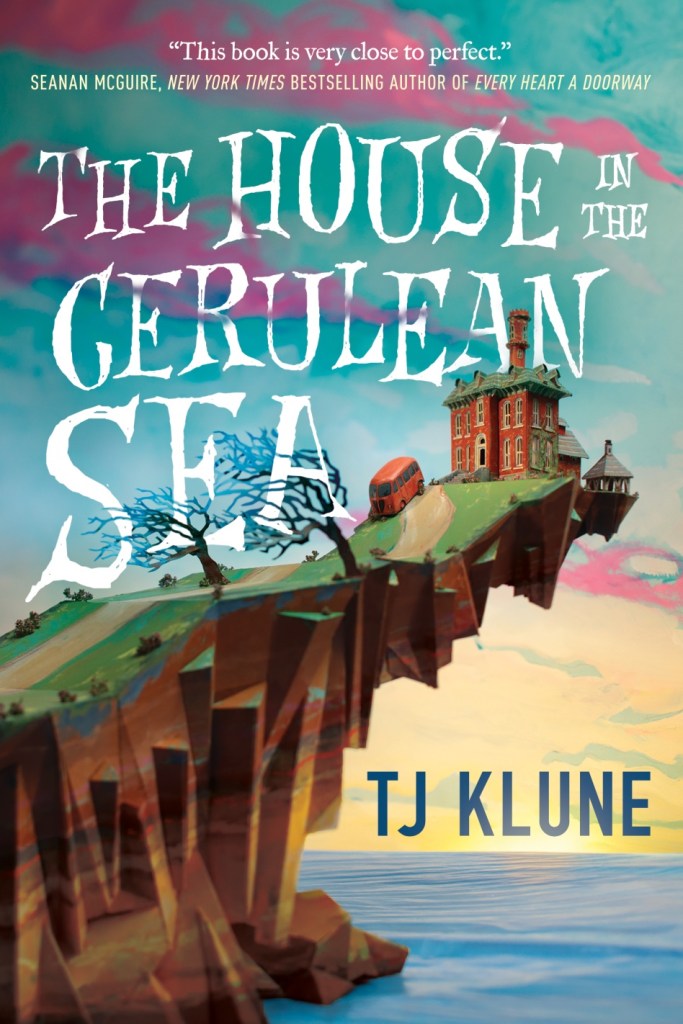
Book: The House in the Cerulean Sea Author: T.J. Klune Release Date: March 2020 Source: borrowed from the library Rating: 6 out of 5 stars (can I do that? Guess, don’t care! Just did!)
The House in the Cerulean Sea follows main character Linus Baker: Linus is overweight and out of shape, he’s forty, he’s desperately lonely, and resigned to his fate. He is a case worker for the Department in Charge of Magical Youth, because in this version of Earth (it IS Earth, they have computers, and record players, and Linus’s favorite music is oldies like The Big Bopper and Sinatra), magical beings exist. But these magical creatures are heavily monitored; they have to be registered and they are not allowed to hold positions of power or authority (in other words, they are a hugely oppressed minority). Linus inspects orphanages for magical youth (not all magical children are orphans but many of them are), but unlike most case workers, Linus really cares about the welfare of the children, and looks for problems like Masters who abuse or take advantage of the children under their care.
With a reputation for being objective, keeping distance from the children, and very thorough, Linus is brought before Very Upper Management, and given a top secret case: to go visit and live at a top secret orphanage on an island, run by a man named Arthur Parnassus, who has six children under his care. Linus is supposed to look for any issues, because Very Upper Management has “reasons for concern.” It seems pretty clear from the get-go, however, that they are just looking for an excuse to shut it down.
Linus arrives at the orphanage to discover that the children there are unlike any other magical children he has ever seen or heard of. These children are: a female garden gnome with the beard and everything!, a Forest sprite more powerful than any other he’s met, a wyvern (whom people used to think of as animals, but do in fact have intelligent and complex emotions and language, just not human language), a tall shy black kid who is a were-POMERANIAN!, a green blob named Chauncey whose greatest ambition in life is to be a BELLHOP, and a six year old boy who is the literal Anti-Christ.
And then there is the Master of the orphanage, Arthur Parnassus, who is very charming and cares deeply for the children under his care. Linus, unsurprisingly, immediately develops a crush on him.
And folks, it just gets more adorable from there!
This book is funny, and charming, and quirky, and delightful in ways I cannot begin to express! It deals with deeply emotional issues like child abuse, and racial (or in this case, SPECIES) prejudice and oppression, and despite this it manages to be one of the happiest, most hopeful books I’ve read in YEARS. I smiled like a madwoman through the whole thing. And when I finished the audiobook from the library and returned it (and saw that there was now a six month wait on the book!), I immediately bought the ebook AND audiobook so I can read it again.
I identified so strongly with poor, put-upon, lonely dumpy Linus — who is finally given the opportunity to show how honorable and good and kind he is while staying at the orphanage — that it is mildly embarrassing. And I fell in love with Arthur and the children right along with Linus, the whole way through. I am a sucker for quirky odd funny characters, and found family tropes, and this book gave it to me in SPADES. I think this might end up being my favorite book of the year. (Unconquerable Sun held that honor a few months ago, and that is still definitely near the top as well!)
I have a handful of books that I love dearly, and will go around used bookstores buying up paperback copies just so that I can hand them off to people I love, whom I want to share my favorite books with. I don’t do this with some books I love that are so well known, I have no doubt most people have at least heard of them, if not read them (so for instance, I don’t generally do this with Dune or Watership Down, even though they are my favorite books of all time, because most people are already familiar with them). Instead, I do this with books I adore that have not gotten quite the same circulation. Books like Sunshine by Robin McKinley, and Dragon Prince by Melanie Rawn, and We by Yevgeny Zamyatin, and Neverending Story by Michael Ende (though the movie is so well known, not nearly as many people have read the book!). I can guarantee that as soon as the paperback version of House in the Cerulean Sea is released next year, this book will definitely be added to that prestigious list. In the meantime, since I cannot buy every single one of you a copy to read (I’m poor, people! Or I totally would!), please please please go do yourselves a favor and GO BUY IT NOW! Or borrow it from the library! Either way, just READ IT!
Edit at 4:20pm: I bought the ebook and audiobook for House in the Cerulean Sea, but I SWORE to myself that I wouldn’t read them until after I finish the other three books I’m SUPPOSED to be reading right now (those being: Name of the Wind, The Arrest, and Hall of Smoke)… but… that resolve may end by tonight… I just LOVED IT SO MUCH FOLKS!
Book: The Daughters of Ys Author: M.T. Anderson (writer)/Jo Rioux (artist) Release Date: May 2020 Source: ARC provided by publisher (obtained through my work) Rating: 4 out of 5 Stars
The Daughters of Ys is a graphic novel written by M.T. Anderson, with art by Jo Rioux, that is based on an old Breton folktale. “Breton” refers to the area of France called Brittany, which actually originally had a Briton/Celtic population, before it was colonized by the Roman Empire, and then was eventually subsumed into France. So the folktales of the area are a very fascinating mix of cultures.
This graphic novel contains beautiful full-color art with a soft color palette and a sweeping style, that tells a sad, foreboding far-reaching story in a surprisingly small, tightly-narrated package.
The Daughters of Ys are two sisters, Rozenn and Dahut, the daughters of King Gradlon of the kingdom of Kerne, who live in the capital city of Ys. The sisters drift apart after the death of their magical (possibly faerie) mother, and follow divergent paths that bring them into conflict with each other. Rozenn, the eldest and heir to the throne, goes to live in the wilds, to be among the plants and animals and away from the riotous parties and debauchery of the capital city. Dahut, the younger, takes on the task of maintaining the kingdom for her increasingly broken and useless father, the king, and revels in the parties and the young men who come to court her. But Dahut has a dark secret. A secret that makes their kingdom the richest and most powerful of all, but at a steep cost. When Dahut and Rozenn come into conflict, one sister betrays the other, and their choices have the potential to ruin the entire kingdom.
This story is a dark lesson in obligation, desire, and what happens when debts finally come due. It is also about the ways that family can fall apart and even destroy each other in the face of competing needs and motivations.
When I first saw the cover, I didn’t care for the art style, but as I got into the story I decided that the style – somewhat loose and soft with a kind of colored pencil texture to it – actually fit the folktale-nature and tone of the narrative. Also, by the end of the story I was very fascinated by the original folktale, and had to go look it up on Wikipedia later. I’m now wondering if there’s a full collection of Breton folktales somewhere, because that would be cool. AND I went in search to see if anyone had written a full novel adaptation of the story, and lo and behold! There is, in fact, a whole 4 book series based on the folktale written by respected SF/Fantasy writer Poul Anderson and his wife/sometimes-coauthor Karen Anderson! So I’ll be looking for those later…
I gave this graphic novel a 4 out of 5 stars. I’m not going to singing its praises to the rafters for weeks, but I did really enjoy it. And I highly recommend it.
Book: Disney’s Land: Walt Disney and the invention of the Amusement Park That Changed the World Author: Richard Snow Release Date: December 2019 Source: Hardcover bought At Barnes & Noble Rating: 5 out of 5 Stars
I love Disney. Let me just be clear about that. I know it’s “cool” right now to criticize Disney (the company as a whole). I see comments and articles all over Twitter and Facebook and such about how horrible the company is, or how the Academy Awards are rigged to give them (more specifically Pixar) the Animated Feature Award every year, or how badly they treat their park employees, etc. I know all these things, and I agree with plenty (though not all) of them. There are many issues with the company as a whole that need to be addressed. Absolutely.
But I still LOVE Disney. Most little kids do, but many adults grow out of it. I never did. I never will. I have no wish to do so. It’s practically a religion to me. I love the movies (most of the time… no, I did not go see the live-action Aladdin nor the “live-action”-but-really-CGI Lion King). I love the tv programs. I love the Marvel movies (despite their many flaws). I haven’t entirely loved what they’ve done to the Star Wars films, but… *shrug* I ADORE the parks. I have loads and loads of Disney merchandise – art books and prints and dolls and pins and and and…
All this is to say: OF COURSE I was going to buy Richard Snow’s new book about the invention and design of Disneyland. And OF COURSE I was going to love it.
Now, Richard Snow is a well respected journalist, editor, and history writer. He has worked a quite a few documentaries including the Burns’ brothers’ The Civil War. And his last book, Iron Dawn: The Monitor, the Merrimack, and the Civil War Sea Battle That Changed History, won a prize for Naval Literature. So perhaps it was a bit odd that a history writer who has written about such serious topics would choose to write about something as “frivolous” as Disneyland. Thankfully, Richard Snow happens to be a HUGE fan of theme parks, and Disneyland in particular, and thankfully his editor and agent give him full rein to explore this topic, and thankfully he knew and PROVED that Disneyland is not such a frivolous topic after all.
His book Disney’s Land: Walt Disney and the Invention of the Amusement Park That Changed the World, is an enormously well-researched deep-dive into not only the park itself, but Walt Disney’s life and frame-of-mind leading up to and during the build of Disneyland, as well as providing snippets into the lives of the many many people (animators, designers, “imagineers”) who made Disneyland possible, all while also keeping the narrative deeply grounded and rooted in its context of post-WW2 1950s America.
To say this book is thorough and filled with more research – primary, secondary, interviews, etc – than you can shake a stick at would be a massive understatement. The bibliographies section is 7 pages long (in small print!) and has given me a mind-bogglingly huge new goal to find and read as many of the materials cited in the book as possible. But more than that, this book is also delightfully well-written: the prose is smart, and entertaining, and often very funny. And Richard Snow approaches the subject with so much respect and love, while remaining balanced, honest, and fair about Walt Disney’s (and others) faults and shortcomings, that I believe even the most hardened anti-Disney heart MUST come away with at least a LITTLE respect for the overall concept and project of Disneyland, and the men and women who made it possible.
If you, like me, love Disney. You absolutely definitely must read this book. If you are a tepid about Disney, I think even YOU might enjoy this read. I also believe that anyone in a creative business would find this book highly enlightening, inspiring, and possibly instructive. So get to it people!
(Next on my list of nonfiction – I read a LOT of nonfiction – is a book on a related topic to this one. It is The Queens of Animation by Nathalia Holt, which is about the women who worked for Disney Animation often with little or no recognition in the early days. One of my favorites of these women is Mary Blair. I’m really looking forward to this book!)
My second official book review for the new blog is here!
As I mentioned previously, I read Steel Crow Saga near the end of 2019, and it was definitely one of my favorite books of the year. As with most of my reading lately, I read this book on Audible (remind me to more fully sing the praises of Audible later, folks!)
So, to the point!
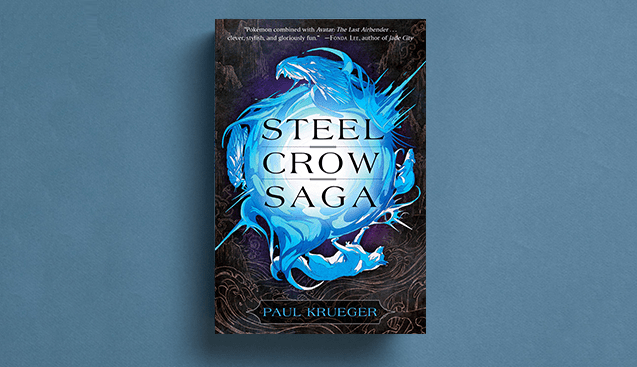
Book: Steel Crow Saga Author: Paul Krueger Source: Bought on Audible Rating: 5 out of 5 Stars
Steel Crow Saga is an absolutely brilliant new fantasy novel (released Sept 2019) by Paul Krueger (this is his second book, having published Last Call at the Nightshade Lounge in 2016 – though I haven’t read that one, I now plan to). In its early marketing it was the tagline “Pokémon combined with Avatar the Last Airbender” (quoted from Fonda Lee) and let me start by saying that that comparison holds up in the best way possible! It was the tagline that sold me on the book (I’m all here for more fantasy and SF writers not only being influenced by anime but actually ADMITTING to it), and I was NOT disappointed.
The world of Steel Crow Saga is inspired by Asian cultures and has a vaguely 1910-1920s feel (it is clearly not modern, there is a somewhat “old-world” feel to it, but there are trains and rudimentary cars, and radio, so…). There are four main Asian-esque countries involved: The Tomoda Empire (based on Japan), the Shang Dynasty (China), The Sanbu Islands (The Philippines), and Jeongson (Korea) with a vaguely Indian-inspired people on the outskirts. Long before the beginning of the novel, The Tomoda Empire had conquered and colonized the other three… If this all has a very ATLA feel to it, you are right… Paul Krueger leans into the comparisons and the homages with joy and abandon, but it never feels like a copy or a rip-off.
The real plot of the novel picks up just after the three colonized countries (Sanbuna, Jeongson, and Shang) have risen up in an enormous rebellion/war and overthrown the Tomoda Empire, and follows the progress of four main characters.
First, there is Prince Jimuro: a prisoner of war for the last two years of the rebellion, Jimuro is the last surviving member of the imperial family of Tomoda, who inherits his throne from the ashes of a defeat. Now he is being permitted by the victors to ascend to his throne in order to solidify Tomoda’s surrender and forge a new peace.
Then there is Tala, a battle-hardened soldier from the Sanbu Islands, who has lost everything she ever loved in the course of the war and carries a terrible, damning secret. She has been tasked with the mission to deliver Jimuro safely to his throne while evading many opposing forces that wish to stop them, and despite the fact that she hates him with a deep, cold fury.
Third is Xiulan, a low-ranking princess of the Shang Dynasty who has become a detective after the style of her favorite (Sherlock Holmes-esque) book character, and who secretly plans to bypass her despised oldest sister to first in line for the throne, by presenting her father with the war criminal Prince Jimuro.
Lastly, there is Lee, a thief and con-artist from an oppressed population within Jeongson, betrayed by her latest partner, whose one rule – “leave them before they leave you” is challenged when Princess Xiulan saves her from the gallows in order to enlist her to the mission to track down and capture Prince Jimuro.
These four characters begin with separate missions and motivations, working along different paths (physically and metaphorically) but will encounter each other and entangle as the narrative progresses. In addition to this four main players, however, we also a have a wide cast of highly important supporting characters including Tala’s brother Dimangan, Jimuro’s childhood friend who happens to be trans, Xiulan’s devious but strangely-compelling oldest sister, and, of course, the primary antagonist who remains nameless through most of the story: a terrifyingly powerful and mysterious man in a long purple coat who has abilities no one should have.
And then there are the shades. This is where the Pokemon references come in, because many of the people in this world have the ability to do what is called “Shade-Pacting” – choosing an animal companion (or more to the point letting the animal choose you) and, essentially, merging parts of your souls to become partners, with the animal shade now living inside you, ready to be called to battle at the call of their name. Tala’s shade companion is a crow. Xiulan possesses a white rat. Lee wants nothing more than to have a shade of her own, despite the fact that her people have never before been allowed to learn how to pact with one. And Jimuro’s people, the Tomodanese find the practice of pacting to be akin to slavery, an act so disgusting to them that it had become one of their most prevalent excuses for colonialism – to stop the Shang and Sanbuna peoples from practicing this barbaric tradition.
To say this novel is jam-packed with world-building and action would be a massive understatement. Paul Krueger constructs this world with an astounding attention to detail, “creating a rich new mythology and characters so real you can smell their pipe smoke and adobo” as Delilah S. Dawson in her blurb for the book. The writing is rich and potent, with the fun addition of dozens of nerdy references (to anime, to movies, to other books, etc) and easter eggs – some of which I still have not identified if Paul Krueger’s twitter feed is to be believed. The action is fast-paced and exciting, with fight sequences that on one hand seem MADE for film, and on the other hand are so deftly described that you can picture them easily without visual aid.
The character development is also written with compassion, sensitivity, and beauty. The characters challenge each other’s prejudices and flaws, learn from each other organic ways, and build relationships and romances with touching, intense, and sometimes comedic, authenticity.
In addition to all of this, the novel is also exceptionally socially and politically aware. It features two bisexual characters, a gay character, and a trans character, all of whom are fully-realized and compassionately written (even when they are being idiots and/or assholes), and who are treated as nothing unusual or Othered by the narrative. The narrative and the characters also reveal and interrogate the complexities of imperialism, colonialism, and racial/ethnic prejudice with the incisiveness, intensity, humanity, and intellectual rigor one might expect in a particularly-well written philosophical or political thesis.
In other words, I really cannot sing this book’s praises loudly enough.
As I wrote in a tweet right after finishing it last year, “come for the kickass magic and fight scenes, stay for the excellent examination of colonialism, imperialism, racial/ethnic prejudice, and family loyalty…”
Can I give it 6 out of 5 stars? Is that allowed? Too bad, I’m doing it anyway!
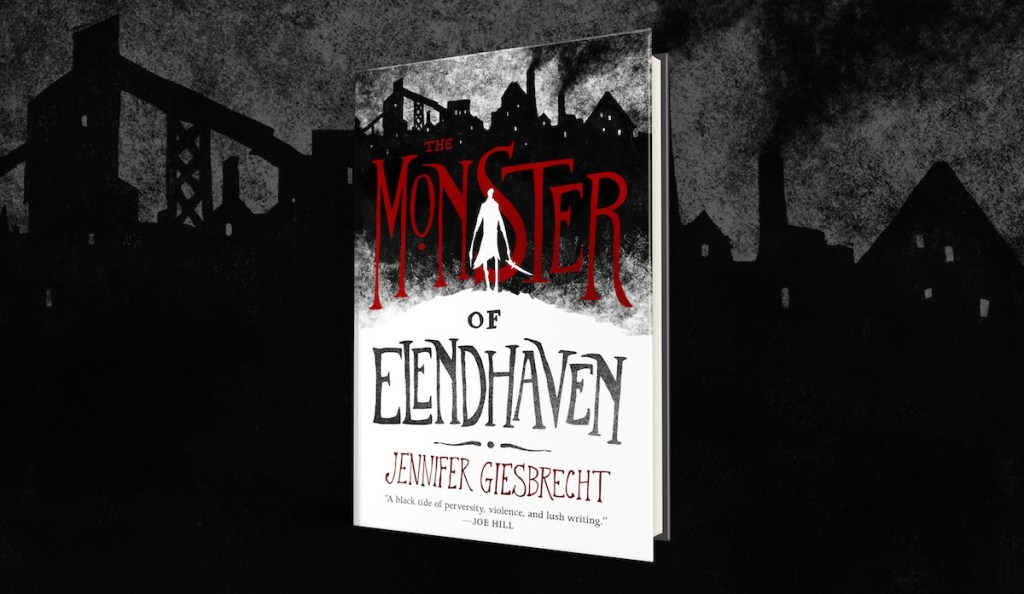
One of the first books I read for my 2020 “Storm the Castle” Reading Challenge was the novella The Monster of Elendhaven by Jennifer Giesbrecht. I read this book on Audible (a good majority of my reading is done through audiobooks these days). It is a fantasy/horror story and it was a) very dark and twisted, b) very good, and c) very gay. I loved it!
I used to write book reviews semi-regularly, but I am very out of practice so this will probably not be horribly structured or formal. And I haven’t decided how I am going to quantify my feelings into a number or star system, so that’s very up-in-the-air right now… (shrug). That said, I will try to keep this review from being TOO spoilery, while still providing enough information for you to decide if this book sounds like something you’d like to check out or not.
The city of Elendhaven lies in the far north, on the edge of a dark, mysterious ocean. It is a city filled with gruesome myths and haunted by plague and betrayal and death. In this city, the story begins with the “birth” or perhaps “creation” of the main character: a creature shaped like a man but not entirely human, a thing with no name until he baptizes himself and decides his name is now Johann. Johann, tall and dark and menacing, yet somehow nearly invisible in society, quickly learns how to make a “living” for himself by whatever criminal and violent means necessary: stealing, stalking, killing, etc. He also discovers that he, apparently, cannot die. Stabbed, beaten, jumping off very tall buildings… it doesn’t matter the method, he does not die.
In the course of his criminal endeavors, Johann begins stalking a wealthy young man he sees often in the bars around the city, named Florian. Florian is small and frail and almost femininely-pretty, but when Johann finally attacks him in a dark alley, Florian is unafraid and unimpressed, but intrigued by the possibilities Johann’s talents might afford him. Florian is, in fact, a sorcerer… possibly the very last one of a breed who have been hunted and executed to near-extinction.
Thus begins a dark, twisted partnership as Johann becomes Florian’s willing servant on a mission of depraved science experiences, murder, and revenge.
oil slick stock image
This novella is black as pitch, sleek and glimmering and beautiful and yet greasy, like an oil slick. It is amazing how much of a punch it packs in a slim 160 pages (about 4.5 hrs on my audiobook)! Johann is violent and terrifying, yet strangely guileless – obsessed with, enamored of delicate but depraved, nearly-heartless Florian. The relationship between the two is a tangle of fascination, disgust, obsession, and deeply-buried genuine affection. And Florian’s plans and motives are so secretive and mysterious that it takes the entirety of the novella to really put together all the pieces. (At one point I thought Florian might be trans, but I was wrong. Gay as shit though). The story is half-horror as Florian instructs Johann to carry out his ruinous revenge of the city and the people who had so horribly wronged him and his family; and it is half-romance as Johann tries to charm Florian with his bizarre mix of flattery, affection, and sado-masochistic penchant for violence.
Jennifer Giesbrecht’s prose is wonderfully baroque, gothic, and poetic. The language lingers, takes it time, stays on the tongue and against the teeth. It features such lines as:
“Power was sweeter than apples. It was cheaper than water, and sustained the soul twice as well. If Johann was going to be a Thing with a name, then from now on he would be a Thing with power, too.”
— Jennifer Giesbrecht, The Monster of Elendhaven
And the first description of the city of Elendhaven is nicely indicative of the tone and style as well:
“Southerners called its harbour the Black Moon of Norden; a fetid crescent that hugged the dark waters of the polar sea. The whole city stank of industry. The air was thick with oil, salt, and smoke, which had long settled into the brick as a slick film, making the streets slippery on even the driest days. It was a foul place: foul scented, foul weathered, and plagued with foul, ugly architecture—squat warehouses peppered with snails and sea grass, mansions carved from heavy, black stone, their thick windows stained green and greasy from exposure to the sea. The tallest points in Elendhaven were the chimneys of the coal refineries. The widest street led south, rutted by the carts that dragged whale offal down from the oil refineries. Hundreds of years ago, the North Pole had been cut open by searing magic, a horrific event that left the land puckered with craters like the one Elendhaven huddled in. For five centuries, the black waters had been poisoned with an arcane toxin that caused the skin to bubble and the mind to go soggy and loose like bread in broth. Once in a while, the fishermen would pull up an aberration from the ocean floor: something frothing and wet with its insides leaking out its eyes. ‘Demons and monsters,’ visitors whispered, ‘such creatures still sleep inside the Black Moon.’”
— Jennifer Giesbrecht, The Monster of Elendhaven
I’ve seen a few reviews of this novella online. Some people really liked it, and others gave it a tepid response, claiming that it starts well but is missing something. I’ll be honest, I’m not sure what they think is missing. Sure, the ending is ambiguous and open-ended, but I think that is all to its merit. I admit I do wonder what could have been, had this story been fleshed out into a full-length novel, but in general I love novellas – I love the big explosive power of the tiny package – and I think this novella works very well. I really enjoyed it, and I believe anyone who likes their fantasy with a horror-twist and a bit of a gut-punch will enjoy it as well.
I’m still shaking out how to do my reviews, but for now I’d say it’s a 4.5 out of 5 stars.








 Amanda Haimoto Rudd