
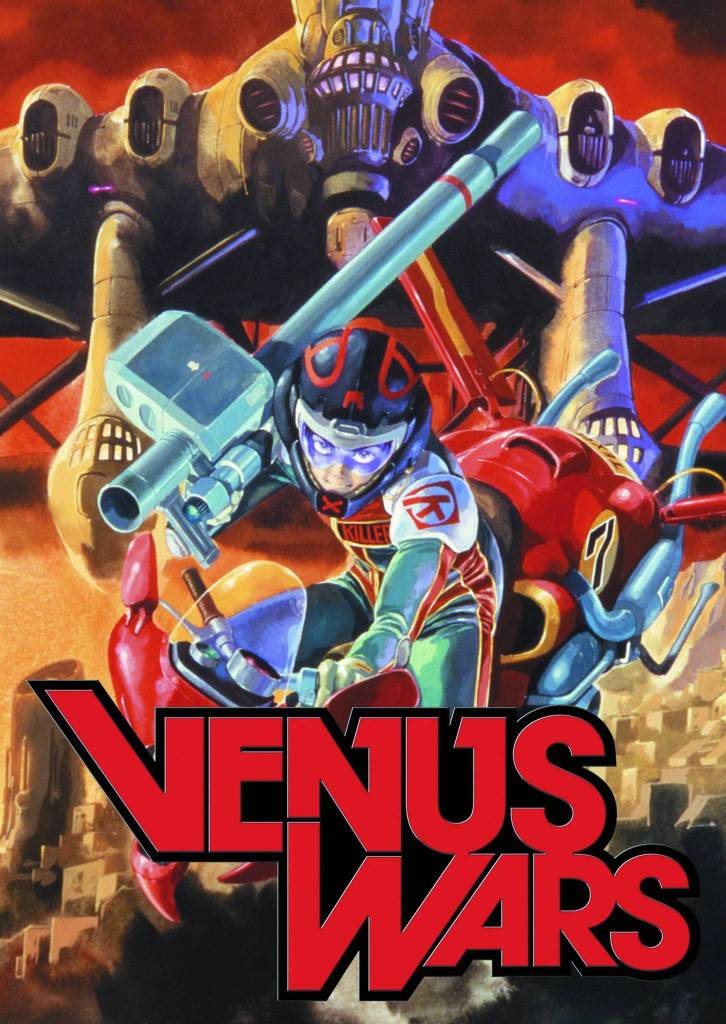
Last night I had the opportunity to see an anime film I hadn’t seen, or even really heard of, before, called Venus Wars. My brother got his hands on a copy of the dvd (apparently not an easy endeavor). And while I know this blog is mostly for books, I think I’ve established by now that I really love anime so I thought I’d share.
Venus Wars is an anime film produced in 1989, based on a manga series of the same name, by Yoshikazu Yasuhiko, that ran from 1987 to 1989. The basic premise of both the manga and the anime is that the planet Venus in 2012 and by the year 2089 it has a population of millions. There are two main continents, Ishtar and Aphrodia (I love the naming, as Venus, Ishtar, and Aphrodite are all goddesses of love), and the two are at war in an attempt to create a unified government. The story opens in the Io, the capital city of Aphrodia, and introduces a team of 80s-style-punk-biker-gang-type racers, who ride battlebikes or “monocycles” (as they only have one wheel). The team includes the main character, hot-headed Hiro (of course!) and several other characters such as Will, and Miranda, the kickass red-head captain of the team (who looks rather a lot like Priss from the 80s Bubblegum Crisis). Simultaneously, we are introduced to Susan Sommers, a blonde, blue-eyed, somewhat bitchy news reporter/war correspondent who has come from peaceful “civilized” Earth to cover the war on Venus. Unsurprisingly, these two sets of main characters meet and team up when a huge force from Ishtar invades Io with gigantic tanks and occupies the city.

I cannot speak to the manga, of course, but I have mixed feelings about the anime. I did enjoy it, and I’m still thinking about it (thus this blog post). It was very 80s in style. Very 80s. Enjoyably 80s, since that’s what I grew up with, but also regrettably 80s in some respects. I loved the animation style. Everything was hand-drawn, for one thing(!), which is not so true these days. And everything had texture and movement and personality. The score, by Joe Hisaishi (who went on to become famous for doing all the Studio Ghibli scores) is fantastic (and also fantastically 80s). But I also had a lot of critiques or complaints.
For one thing, the movie felt contradictorily too long and crammed with too much plot, while also feeling a little thin on plot at the same time. What I mean though, is that there was A LOT going on, and there is a lot of meat on the bones of the story, BUT the writers were clearly trying to shove WAY too much of the plot of the much longer manga into 100 minutes, leading to a story that was too cramped and jumped around too much, while not giving enough time to fully develop either the characters, or the actual actions of the plot.
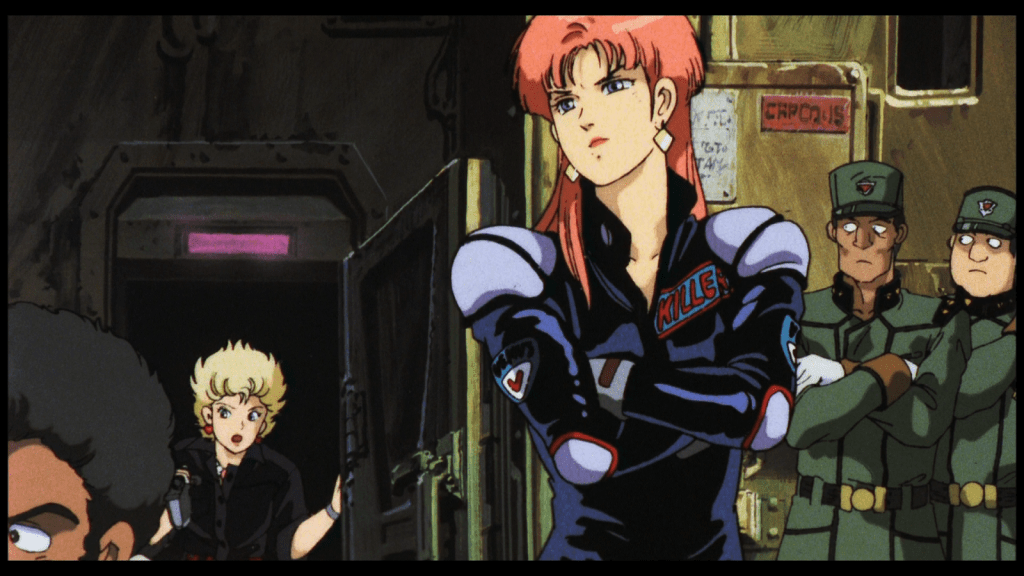
A lot of the characters were pretty flat, some of the motivations made little sense, some characters popped up quickly for no apparent reason and disappeared again just as quickly and with just as little reason. The setting/world-building was not particularly well-established, such that I spent the first 20 minutes or so just trying to figure out who had invaded who — I couldn’t tell if the city Io was in Ishtar or Aphrodia and therefore couldn’t tell which government was supposed to be the “bad guy.” Some of the jumps in scene and time were also confusing and difficult to follow. And the whole story supposedly takes place over the course of just 3 or 4 days, which makes some of the character relationships dubious at best (the blonde reporter, Susan, falls in love with Will the racer in like… the blink of an eye?).
All that said, I did actually enjoy the movie, and I think it did some really interesting things with its depictions of war. The racers, young and stupid, are very excited about the prospect of war and fighting at first (at teenagers often are), and then the movie spends a great deal of time beating that out of them, so that by the end all of them have bailed on the fighting. Likewise, war correspondent Susan Sommers is creepily gleeful about the invasion at the beginning of the movie, filming everything with her little handheld camera and urging the tanks to keep firing until they start firing at her, and she gets angry. But by the end of the movie, she has witnessed some of the true horrors of war and has gained much needed compassion and anger at the various injustices.
I can only imagine that the manga has the time and space to do full justice to both the characters and the themes of the story, that the movie can only vaguely gesture at.
(I will note that there are a couple pretty offensive bits: some really sexist comments thrown around with so much as a blink of an eye, and a random gay soldier who makes an appearance near the end for no apparent reason other than to revel in an offensive stereotype and then get killed. These bits are unfortunately par for the course in the 80s, but still infuriating.)
On the whole though, I liked it well enough to still be thinking about it, and to start digging around online for the manga, which apparently has been out of print since 1993… so, happy hunting to me, I guess?







 Amanda Haimoto Rudd