
Now that the first (but thankfully, not last) season of Apple TV’s Murderbot series has wrapped up, I thought it would be fun to chat about it for a bit. For those not in the know, the Murderbot TV show comes from showrunners Paul and Chris Weitz (who have directed and/produced many films and tv shows both together and separately) and stars Alexander Skarsgard in the title role. The show is adapted from the science fiction novella series, The Murderbot Diaries by Martha Wells. The first season specifically adapts the first installment in the series, All Systems Red.
Spoiler Warning: As I am speaking in broad terms about the whole season of Murderbot AND the book series to some degree, this is going to be very spoiler heavy. Continue at your own risk.

The series follows the self-named Murderbot, a construct (part organic, part tech) Security Unit (SecUnit) who comes from the dystopian-ish Corporation Rim, a series of aligned systems, worlds, and corporate entities that control much of the galaxy. In the Corporation Rim, SecUnits and other constructs are considered objects to be owned, not sentient beings with lives and rights. SecUnits are leased as equipment. If they do not obey orders and fulfill their contracts, they can be punished, erased, or dismantled. And they are controlled by Governor Modules built into their systems. But Murderbot has secretly hacked its Governor Module, meaning that it is no longer forced to follow orders. What does it do with this freedom? It keeps doing its job anyway, and spends its free time consuming media (television dramas, music, etc.). In the first book, All Systems Red, Murderbot is leased on a contract to a team of researchers on an alien planet. This research team, PresAux, comes from a non-corporate-aligned free world called Preservation Alliance that is, basically, a socialist democratic utopia. The group becomes entangled in a conspiracy of coporate espionage and murder, requiring Murderbot to save its human clients from death while trying to hide the fact that it is, in fact, a rogue unit. Shenanigans ensue, of course.

The novella series is hugely popular. I’ve been reading them almost since the beginning (I think I picked them up when the third book was a new release? But I don’t really remember). I love these books with all my heart (I keep shoving them at people, including my best friend, my mother, my brother, etc). And I was so ecstatic when Apple TV announced their adaptation. That’s not to say there wasn’t some worry. There always is when a beloved book is adapted for screen. The process does not always go well, and often distorts the original work out of all recognition. Still, I was hopeful because Apple TV has a good track record with their science fiction properties, giving them good budgets, good actors, good marketing, and usually at least a few seasons (unlike the other big streaming entity… cough Netlfix cough).
As the show’s release got closer and more news was revealed bit by bit, some fans were concerned about the choice to cast Alexander Skarsgard in the lead role. Murderbot is very explicitly non-gendered and uses it/its pronouns. Some felt that Skarsgard was too blatantly masculine for the role. I was particularly intrigued by the discussions on Reddit and elsewhere between fans arguing over whether Murderbot was canonically more masculine or feminine presenting in physical appearance. A number of fans professed that the always pictured it with more feminine features. This has fascinated me because, while Murderbot is genderless, or nonbinary, the cover art on the books give Murderbot (at least to my eyes) a masculine-leaning body type (which Martha Wells approved). And the characters around Murderbot describe it as tall and intimidating, which to me generally means at least nominally male (obviously women can be tall and intimidating too, but still). Additionally, the novellas are all written in first-person narration, from Murderbot’s perspective, and the audiobooks are narrated by Kevin R. Free. A masculine voice (which Martha Wells approved). I think, for better or worse, there is a common image in people’s minds that being nonbinary or non-gendered means, by its nature, being androgynous. But a person can look physically very masculine and still be nonbinary, or agender.

Suffice to say, some fans were concerned.
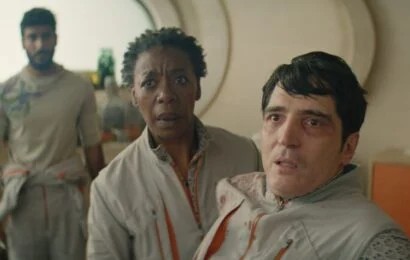
I believe that Alexander Skarsgard allayed all those concerned by the end of the first episode of the series. And then blew them all out of the water in the subsequent episodes. All of the acting is excellent, of course. The basically unanimous opinion is that Noma Dumezweni as Ayda Mensah, and David Dastmalchian as Gurathin, were particularly amazing in their roles. But, perhaps unsurprisingly, the standout performance comes from Skarsgard, who absolutely knocked it out of the park. Skarsgard perfectly captures Murderbot’s awkwardness and social anxiety. One of the things that I love about the character in the books is Murderbot’s disdain for emotions, its constant insistence that it absolutely does not feel things like concern or caring or attachment for its soft, squishy human clients even as its actions prove the opposite. Skarsgard’s facial expressions, his use of his eyes in particular, is subtle and effective, wonderfully portraying Murderbot’s efforts to pretend it does not have emotions while actively displaying them.
In addition to the acting, I feel the design work really stands out. The design and look of the sets, the technology, the worlds, the alien animals, and so on was really phenomenal. It felt appropriately SF-ish and space-opera-y, but also solid and real and lived-in. The designers, writers, and so forth really paid attention to the fine detail work, and that often makes all the difference.

For the most part, I also feel the show captures the vibe of the books, which are SF adventure with a deeply comedic edge to them, due primarily to Murderbot’s dry, self-deprecating and sardonic first-person narration. The show tried to tread a careful line between action-adventure and comedy. While some complained about the voice-over narration, I personally feel that you could not have Murderbot without the voice-over narration. Basically the entire book series is nothing but voice-over narration, as Murderbot recounts its adventures to a log. And I felt the Skarsgard’s delivery of Murderbot’s commentary, all dry wit and heavy sarcasm, was absolutely spot-on.
That said, I do feel that the show’s efforts to balance the comedic tone was not always successful. At times, especially in the first half of the season, it sometimes felt too sitcom-y to me. The human researchers were just a bit too bumbling. A bit too silly. The gags and pratfalls were a bit too over-the-top. Even as the story turns more serious by the end, the human characters (particularly Ratthi, Pin-Lee, and Arada) were just a bit too cartoonishly naive. Mensah and Gurathin have some weight and complexity. The others, not so much. To be fair, the first book does not flesh them out in immense detail either. That happens slowly over several books. Still, in an effort to craft characters with minimal material to work from, the show leans far too heavily on the idea of Preservation Alliance as a space-hippie commune gag and makes the characters appear more like clueless idiot children, rather than naive but still perfectly competent professionals. These are, after all, all scientists and researchers (well, Pin-Lee is a lawyer, but same idea).

I had some other minor quibbles with some writing/directing choices in the show, but that was my one sort of major complaint. And, clearly, it wasn’t so damning an issue that I stopped watching. I did not love all the choices and changes made. I recognize that every book-to-screen adaptation makes changes. That is the nature of the game, and I am generally pretty good at separating the two. Some changes are necessary because of format differences, or because some things simply do not work as well on screen as they do in written form, and vice versa. Some changes happen to fill in details. After all, All Systems Red is a short novella. The world-building details are limited and strategically placed for maximum effect. But by its nature, a visual media requires far more detail. So the showrunners, writers, and designers have to make up a lot to fill in all the gaps. And for the most part, I think the Wietz Brothers, et al, did a phenomenal job of doing this. For instance, the addition of scenes from the in-universe Rise and Fall of Sanctuary Moon show was hilarious, glorious even (John Cho and Clark Gregg are having way too much fun in those scenes). But some changes just felt… odd and unnecessary. Not required by either the format or the narrative. For instance, the LeBeeBee character was strange and, to me vat least, really annoying (I recognize that quite a few people on the Murderbot Reddit that she was amusing). But again, these complaints are fairly minor, all things considered.
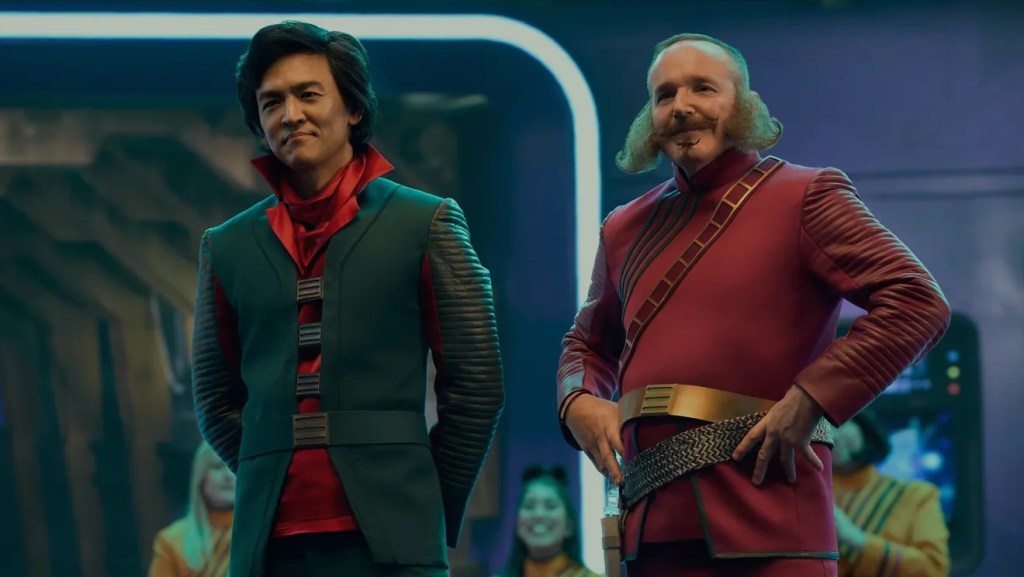
On the whole, I really enjoyed the series. It was fun and high-energy and entertaining, with some really great film work and some phenomenal acting. I was excited for the new episode every week, and I am ecstatic that it has been confirmed for a second season. I’ve watched every episode 2-3 times now. And I suspect a book series re-read is in order soon, at which point I will probably go through the season again with new eyes. And in the meantime, I am already enjoying the lively discussions in fandom spaces about what Paul and Chris Weitz will do with the second season. One thing I am particularly curious about is how they will address the fact that none of the PresAux team appear in books 2 and 3. Will they stay true to the books and portray Murderbot’s solo adventures? Or will they rework the material somehow so that they can keep the current cast of characters involved in some way. Given the love almost every fan has professed for Gurathin in particular, I honestly would not blame them if they did keep him around somehow. It’ll likely be a year or two before we’ll find out, but I can’t wait to see!






 Amanda Haimoto Rudd