Movie Review: BARBIE

Official film poster

The Barbie movie from director Greta Gerwig and lead actors Margot Robbie and Ryan Gosling, was actually shockingly good. I remember being amused by the trailers, and increasingly excited by the reviews (including the whiny male-tears reviews which made me cackle), but I wanted to go into the movie without too high of an expectation. I’ve been disappointed by hype before. But in fact, it was a bit better than I was even expecting.

Visually, it’s stunning. The set, prop, and costume design were impeccable. I don’t know how they made everything really look like giant life-size versions of plastic toys, but they did. The colors are amazing. And even in the switch from “Barbie Land” to the “Real World” the cinematography remains bright and light, even while giving way to more realistic color palettes and lighting choices.
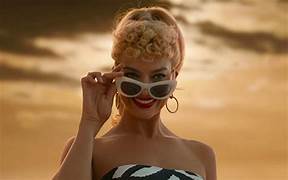
opening scene of Barbie movie, with 2001: A Space Odyssey homage

It was also, frankly, hilarious. I laughed so much, folks. So much. I want to talk about this without giving too much away (but it has been out for a few weeks now so I feel some spoilers are inevitable). Let me just say, the movie opens with a sequence that references (nearly shot for shot in some places) to 2001: A Space Odyssey, with Barbie as the black monolith. I immediately cracked up. That was all I needed. The movie had me from that point on. But it kept getting funnier. One thing I appreciated was the layering of humor. There were parts that were clearly meant to be funny to kids, and some sequences that even straight (well-adjusted) men could find amusing. And then there were all the bits that felt like they were just for me. For left-leaning, adult women who grew up with Barbies and understood the dozens and dozens of references that would go right over the heads of younger girls and were probably too niche for other adults. I was probably the person in the theatre laughing the loudest (this is a fairly common occurrence for me, to be fair. I was by far the loudest laugher in the theatre when I saw The Emperor’s New Groove, for instance).

I also think the movie was very smart and genuine. Earnest even, underneath all the jokes and slapstick comedy.

I’ve been paying attention to a lot of the criticisms and complaints about the movie. Obviously, there’s all the conservative straight (mostly white) men so entangled in their own toxic masculinity and patriarchal power, and crying their pathetic man tears over the awful man-hating “woke” movie. And I have nothing to say to or about those people. I’m not wasting my energy on that. But there have also been critiques from the other side of the aisle, from leftist feminist women complaining that the movie is too simplistic, or dumbed-down, or doesn’t push far enough, etc. And that actually bugs me a little.

Barbie (Margot Robbie) and Ken (Ryan Gosling)

Is the movie particularly nuanced? Of course not. It’s not an academic article on gender theory by Judith Butler. It’s not out here trying to be the next Feminine Mystique, or break new ground in feminist thought. It’s a big-budget summer blockbuster aimed mostly at kids and young women, about a toy, paid for by Mattel. But looked at from that angle – from the angle of a movie built largely to make money, produced by MATTEL – than you have to admit that it’s shockingly smart, with a genuinely good argument/message, and that Greta Gerwig et. al. got a way with a lot. I mean, A LOT.

I mean! There’s a scene where Barbie is shocked to discover the CEO of Mattel is a man, and that there are no men in positions of power in the company. To which the CEO responds (I’m paraphrasing here): “I love women! I’m the son of a woman! I’m the… nephew of an aunt! Some of my best friends are… Jewish!” Clearly highlighting the way he’s so busy trying to defend himself for doing/saying something offensive that he’s forgotten which (of many, no doubt) offensive thing he’s done this time that needs defending. I died laughing.

I’ll also add that while the focus of the movie and the messaging is clearly (and rightfully) on women, their struggles, their pain, their gaze, the movie also still manages to convey the idea that patriarchy and toxic masculinity are just as damaging for the men. None of the men in this movie (least of all Ken) is happy within this system. And the movie is clearly pointing out that they don’t have to feel that way, or live that way!
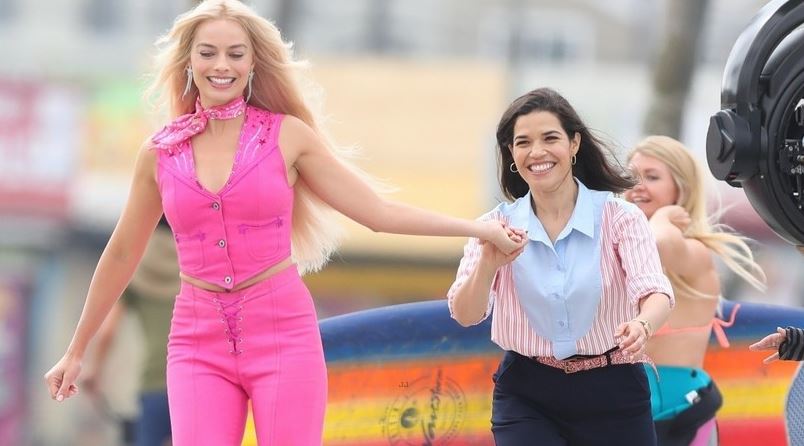
Barbie (Margot Robbie) and Gloria (America Ferrara)

But America Ferrara’s speech in the last third of the movie was genuinely powerful, and moving, and absolutely stole the show. I saw this movie with my mother, and she absolutely cried during that speech. And she’s a boomer!

Even my brother, who was by far not the target-audience and only came with me out of boredom, admitted that it was funny and enjoyable. Truly, the only demographic who are really not going to like this movie are the thin-skinned white men who are happy to remain in the chokehold of toxic masculinity and enjoy the unjust power that patriarchy has given them. And, frankly, if that’s you, I’d be shocked you’re reading my blog at all. Otherwise, I feel fairly confident that you’ll find the movie at least amusing, if not outright amazing.

(Side note: also, all the memes have been GLORIOUS online.)

Book Review: The Last Drop of Hemlock

Title: The Last Drop of Hemlock
Author: Katharine Schellman
Release Date: 6 June 2023
How I Got It: Bought print copy
Rating: 4 Stars

Last year I wrote a review for Katharine Schellman’s book Last Call at the Nightingale, which is a Jazz Age-set historical murder mystery. You can find that first review here. The sequel to that book came out in June, so of course I had to get it. I’ve mentioned before (I think) that Schellman became an instant-buy author for me the minute I read her debut novel, a regency-era mystery called The Body in the Garden, which came out in 2020 and which I wrote about here. I am so happy I found this author. I have loved everything she’s published so far, and this newest book, The Last Drop of Hemlock, is no exception.

The Last Drop of Hemlock picks up a couple months after the end of Nightingale (you will need to read the first book to get some reference and know who all the main players are). Our resident disaster bi (and my personal mascot) Vivian Kelly (Viv) is getting used to her new job working at the Nightingale, the speakeasy owned by the dangerous woman she is dangerously attracted to, Honor. As she did in the first book, Viv quickly finds herself entangled in a murder: this time she has promised to help her best friend Bea find out who murdered her uncle with poisoned whiskey. This investigation leads her to asking for favors from Leo, whom she has indecisively kept at a distance since learning of his deception at the end of the first book. She also has to make deals with mobsters, gets attacked, uncovers a bizarre plot of threats and blackmail, and steals a priceless dress covered in gems.

In the midst of this, she finally convinces her straight-laced sister, Florence, to come to the Nightingale where Honor’s right-hand man, Danny, takes an immediate liking to her and the two begin a (truly sweet and adorable) flirtation. For reasons Viv can hardly explain even to herself this budding relationship makes her strangely jealous. It’s not that she has any designs on Danny for herself. It’s more that she is lonely, stuck and confused by her attractions to both Honor and Leo, and hurt by Honor’s decision to push her away despite acknowledging that the attraction is mutual. So, even though she is happy that her serious sister is having fun, becoming more joyful, she is also afraid of losing her place in Florence’s affections, and she’s jealous that she has not likewise found someone who makes her happy the way Danny seems to make Florence happy.

I would say this installment is not quite as good as the first, which I absolutely adored. But it’s still a ton of fun. The murder mystery in this book doesn’t shock me the way the first one did. The way all the pieces fall together in the end is still very satisfying, but I did actually figure it out ahead of the characters this time, which I did not quite manage in the first book.

As with the first book, the research and attention to historical detail is impeccable. As someone who is trying (and mostly failing) to write a 1920s set historical fiction novel, I know how much work that takes, and I am duly impressed. Schellman really does a great job building the setting with rich detail. This version of Jazz Age New York feels real and lived in. The Nightingale in particular comes to life with technicolor and Dolby surround sound. And even the streets and shops and Chinatown and the various incidental characters that live there all feel real and alive.

There are many things I love about the series in general. First, of course, is Viv. As a disaster bi myself, I have a lot of fellow-feeling for Viv. For her chaotic tendencies, her attractions to two very different but both wildly appealing people, her confusion, her need to get lost in the smoke and the sweat and the music at the speakeasy. This is a character I know and understand. One of the things about this installment was getting to see/learn more of the other supporting characters, especially Bea, Florence, and Danny.

I also really liked some of the small bits of social commentary threaded throughout the plot. As Danny shows Viv and Florence his home in Chinatown, they (and we as the readers) learn more about the way the Chinese immigrant community lived in the 20s, and the kinds of racism and obstacles they had to face when they arrived in New York. These books (both of them, but especially this one) also do not shy away from examining the huge gaps between the wealthy and the working class during this time period. So often, Jazz Age stories focus on the wild lives of the rich, but this book stays with the working class and the poor. The ones living in cheap, rundown tenements, who are struggling to scrape by. And in these spaces we see the ways these working class communities supported each other and helped each other in times of crisis. This is one of the biggest strengths of the book in my opinion.

Was this book on quite the same level as the previous one? No. But that is a common issue with the follow-up to a strong opener. That said, I did still really enjoy it and recommend it. And I am looking forward to the next installment. The ending of the Last Drop of Hemlock does, of course, wrap up the big mystery plot of the novel. But it opens up new possibilities for Viv’s personal/romantic life that I am very excited to return to. I am also interested in seeing how the budding romance between Florence and Danny shakes out. Obviously, I don’t know for certain that there will be a next book, but mystery novels like this tend to be popular in long-series form, and provided this one does well enough it seems a safe bet to assume there will be a follow up.

In the meantime, Murder at Midnight – the next book in Katharine Schellman’s other series, the Lily Adler Mysteries, is due out in September. As I said at the top of this post, the first Lily Adler book was Schellman’s debut and I loved it so much that she became an instant-buy for me based on that single book. The third book in the series came out last year, and while I absolutely enjoyed it, I felt strongly that it suffered from missing Lily Adler’s staunch supporter, Captain Jack Hartley. It seems like he should be back in the next book and I am SO excited for it. Yes, I swoon over this character. So sue me. (Don’t actually sue me, I have no money.) If you read these books you will probably understand. And in all fairness, I’m also swooning over Lily the entire time too. And in the grand tradition of many murder mystery series, this one appears to be a Christmas installment!

So, you will no doubt be getting another Katharine Schellman-centered book review in September.

Book Review: the Monk & Robot Duology

Title: A Psalm for the Wild-Built (Book 1), A Prayer for the Crown-Shy (Book 2)
Author: Becky Chambers
Publication Dates: 2021, 2022
How I Got Them: Bought in print
Rating: 5 stars! 6! 7!

As I try to get myself back into the swing of full book reviews – and I hadn’t meant to go so long without any! I’m still reading plenty, but writing the reviews has proven too much for my brain lately – I wanted to talk about Becky Chambers’ two Monk & Robot novellas. I read them a few months ago, and they now live rent free in my brain forever. Hell, they are hooked into my ribs and refuse to let go. They made me Feel Things ™, and I was not prepared. I’d heard Becky Chambers was good at that, but these were the first of her books I’d read (I also own The Long Way to Small Angry Planet, but haven’t had a chance to read it yet).

Both books take place in a post-industrial, ecologically-rich utopian society called Panga, where centuries before the stories take place, the robots built to serve humans suddenly and mysteriously gained full sentience, put away their tools, and wandered off into the wilderness never to be seen or heard from again. The humans have since learned the error of their ways (in terms of industrialization, ecological destruction, etc), and now live without robots, mostly in balance with their environments, and at peace with each other. It is left up to guesswork and interpretation if this world is meant to be Earth far far in the future, or another world entirely, with many similarities.

In Panga, we meet the nonbinary (they/them) monk, Sibling Dex who, in the throes of a pervasive ennui and feeling of unfulfilled potential, leaves the safety and comfort of their home monastery to become a traveling tea monk. As a tea monk, they administer comfort, advice, and tea to the far-flung towns and villages on the outskirts of human civilization. Dex becomes very good at this, and highly loved and respected by the villages they frequent. Yet after a couple years, they find even this calling unsatisfying. Dex is filled with yearning, for peace or purpose or something they can’t even name. And so, on a whim, they start journeying out into the uncharted, unforgiving wilderness beyond the villages, in search of a centuries-lost monastery they read about in a history book.

On the way, Dex has the shock of their life when they stumble upon a robot, Splendid Speckled Mosscap, who has been sent by agreement with many other robots, to find humans and attempt to understand them, asking them “what do you need?” This is the first interaction between robots and humans since the robots disappeared centuries before.

Dex and Mosscap team up to travel to the lost monastery, engaging in deep philosophical debates along the way and building toward an odd and marvelous friendship.

The second book picks up directly from the ending of the first book, with Dex and Mosscap journeying back into human civilization so that Mosscap can meet with humans in each village and ask them its question: “what do you need?” On this journey, Mosscap faces its own sense of mortality, and realizes that it is changed merely through interaction with humans. Meanwhile, Dex continues to wrestle with their sense of dissatisfaction, lack of purpose, and desire for fulfillment. We also meet Dex’s family, see many, often contradictory, reactions as humans come face to face with a robot, and have more philosophical debates. While the ending of the second book is satisfying, I still find myself hoping for more. There’s been no talk of another novella yet. Perhaps these two are all Becky Chambers intends to say on the matter, but I hope she returns to Dex and Mosscap eventually.

The first book is essentially one long philosophical discussion wrapped in a beautiful package of lush idyllic wilderness, gentle friendship, and warm fragrant tea.

The second book continues that philosophical discussion, but with more interaction with other characters and a few uncomfortable moments as Dex and Mosscap deal with potentially less-tolerant humans. However, both books are gentle and quiet. Not a lot of “Plot” happens. Dex and Mosscap are traveling, but most of the journeying and tension is internal, emotional. The world and characters of these books are diverse and welcoming and comforting and thoughtful, and the questions asked by Dex and by the text are deeply human and complicated.

Dex’s dissatisfaction with their life could, on one level, be criticized as “first world problems.” After all, Dex’s world is utopian: peaceful and comfortable, people’s needs are met, their desires permitted and catered to wherever possible. No one, as far as one can tell, is starving, or being oppressed. What, then, is there to complain about? Nothing, really. Which is part of Dex’s problem, because they feel guilty about feeling unsettled and dissatisfied and unfulfilled. They feel they have no right to their dissatisfaction, but knowing this does not make the feeling go away.

And I think that’s where these books get at the heart of the matter. Mosscap asks the humans: “what do you need?” and most of the humans HAVE NO IDEA. Some of them seem perfectly content with what they have. Some of them simply don’t know how to answer the question. Some can’t even decide what the difference is between a “need” and a “want.” What does one need? What does one want? Are they the same thing?

Dex’s ennui is deeply human and real. A feeling I recognize in myself. They want happiness, but what is happiness? They want purpose, but each time they think they’ve found it it proves fleeting, unfulfilling, illusory. They fear that there is something wrong with them, something broken, so that nothing will ever feel RIGHT, even though everyone else around them seems just fine.

Dex asks:

“Still. Something is missing. Something is off. So, how fucking spoiled am I, then? How fucking broken? What is wrong with me that I can have everything I could ever want and have ever asked for and still wake up in the morning feeling like every day is a slog?”

I know this feeling intimately.

These books made me cry at least half a dozen times.

These books have fingers that dig into my sternum and grasp at the churning maelstrom of feeling beneath.

They don’t provide easy answers, but possibilities. Mosscap offers a wisdom born of nature, of thoughtful reflection and an almost Zen sensibility (Dex is a monk of a made-up “fantasy” religion concerning six gods, but I’d argue that they have a distinctly Buddhist quality to them).

Mosscap offers this particular bit of advice:

“You’re an animal, Sibling Dex. You are not separate or other. You’re an animal. And animals have no purpose. Nothing has a purpose. The world simply is. If you want to do things that are meaningful to others, fine! Good! So do I! But if I wanted to crawl into a cave and watch stalagmites with Frostfrog for the remainder of my days, that would also be both fine and good. You keep asking why your work is not enough, and I don’t know how to answer that, because it is enough to exist in the world and marvel at it. You don’t need to justify that, or earn it. You are allowed to just live. That is all most animals do.”

Similarly, in the second book, Dex states:

“You don’t have to have a reason to be tired. You don’t have to earn rest or comfort. You’re allowed to just be. I say that wherever I go.” They threw a hand toward their wagon, its wooden sides emblazoned with the summer bear. “It’s painted on the side of my home! But I don’t feel like it’s true, for me. I feel like it’s true for everyone else but not me. I feel like I have to do more than that. Like I have a responsibility to do more than that.”

Of course, in our own world, where capitalism rages unchecked and survival is far from assured, we are not “allowed to just live” and we usually do have to work in order to justify our right to exist in the world. Rest has to be earned purely because society has demanded it. But the Monk & Robot books imagine a world where this might no longer be necessary and it’s a beautiful, hopeful thought.

The second book, Prayer for the Crown-Shy, pushes beyond this by suggesting that, perhaps, the answer is in our connections with other people. In our friendships, and loves, and communities. As Dex and Mosscap travel through parts of Panga in the second book, stopping at each village to ask people what they need, the answer (not always explicitly stated, but often implied by their own interactions with people), is EACH OTHER. This is true for Dex as they reconnect with their family, and make possibly romantic connections with someone they meet while traveling. But it is at its most true at the end when, having nearly reached their final destination and inevitable separation, Dex and Mosscap stop where they’re at. Because they’d rather stay together. They find an answer in each other, in their companionship and gentle, complicated, beautiful friendship.

Dex says:

“What if that is enough, for now? What if we’re both trying to answer something much too big before we’ve answered the small thing we should have started with? What if it’s enough to just be…Us.”

Is it enough? I don’t know. In THIS world, possibly not. But what a hopeful, marvelous idea that it someday could be.

My Short Story is Officially Published

Hello folks! I wanted to share happy bit of personal news. My short story, “In the Empty Rooms” has been published by online lit magazine Haven Speculative, and is now officially out to the public today. It’s part of Issue 10 on their site.

Haven Speculative is an entirely volunteer, non-pro magazine that could use any and all support you can spare! They publish all stories and poetry for free on their site, but you can also download an ebook version of each issue by subscribing to their patreon, which I highly recommend. They are publishing some great work by new up-and-coming authors.

I particularly loved To Kneel at the Altar of Your Bones by Valo Wing, from Issue 8 back in March. (Fun fact: I had the pleasure of working with Valo during the Futurescapes Workshop last August).

Anyway, you can find the whole issue at havenspec.com and my story can be found here: “In the Empty Rooms” by Amanda Haimoto Rudd.

Time Travel Narratives Recommended Reading List

To wrap up my little mini series of blog posts about time travel narratives, I am ending with a fairly large recommended reading and viewing list. There’s a bunch of stuff on here, some nonfiction books about the science and theories of time travel, an enormous list of novels, a couple anthologies, and bunch of movies, and a handful of relevant tv shows (mostly from Star Trek, which is famous for their time travel episodes).

This list is not remotely exhaustive. There are hundreds and hundreds of possible books and other media to include in this list. But this is a pretty place to start. It’s a fairly representative list of the most well-known and popular media on the subject. I have not read all of these books, or watched all of these movies (though I have at least some familiarity with a large majority of them).

I have them separated into categories, but they are not in any kind of order whatsoever (not chronological, alphabetical, or quality). Sorry, I was too lazy to work that much out. In any case, have fun with this list!

Non-Fiction Books:

  • Time Travel: The Popular Philosophy of Narrative by David Wittenberg
  • How To Build A Time Machine: The Science Between Time Travel by Brian Clegg
  • Black Holes and Time Warps: Einstein’s Outrageous Legacy by Kip S. Thorne
  • The Science of Interstellar by Kip S. Thorne
  • Time Traveler: A Scientist’s Personal Mission to Make Time Travel a Reality by Dr. Ronald Mallett and Bruce Henderson
  • The Order of Time by Carlo Rovelli
  • Time Travel in Einstein’s Universe: The Physical Possibilities of Travel Through Time by J. Richard Gott

Anthologies:

  • The Time Traveler’s Almanac, edited by Ann and Jeff Vandermeer
  • The Best Time Travel Stories of the 20th Century, edited by Harry Turtledove and Martin H. Greenburg

Novels:

  • The Time Machine by H.G. Wells
  • Time and Again by Jack Finney
  • From Time to Time by Jack Finney
  • End of Eternity by Isaac Asimov
  • Slaughterhouse-Five by Kurt Vonnegut, Jr.
  • Time Enough for Love by Robert A. Heinlein
  • A Connecticut Yankee in King Arthur’s Court by Mark Twain
  • The House on the Strand by Daphne DuMaurier
  • The Man Who Folded Himself by David Gerrold
  • A Wrinkle in Time by Madeleine L’Engle
  • Kindred by Octavia Butler
  • Hyperion by Dan Simmons
  • The Time Traveler’s Wife by Audrey Niffenegger
  • The First Fifteen Lives of Harry August by Claire North
  • Outlander by Diana Gabaldon (Book 1 of the Outlander series)
  • Timeline by Michael Crichton
  • Woman on the Edge of Time by Marge Piercy
  • The Accidental Time Machine by Joe Haldeman
  • The Shining Girls by Lauren Beukes
  • 11/22/63 by Stephen King
  • Doomsday Book by Connie Willis
  • To Say Nothing of the Dog by Connie Willis
  • Black Out/All Clear by Connie Willis
  • How to Live Safely in a Science Fictional Universe by Charles Yu
  • This Is How You Lose the Time War by Amal El-Mohtar and Max Gladstone
  • All You Need Is Kill by Hiroshi Sakurazaka 
  • Recursion by Black Crouch
  • Just One Damn Thing After Another by Jodi Taylor (Book 1 of Chronicles of St. Mary’s series)

Movies:

screenshot from The Time Machine (1960)
  • The Time Machine (1960)
  • Terminator
  • Terminator 2
  • Looper
  • Primer
  • Back to the Future
  • Time After Time
  • Planet of the Apes
  • Donnie Darko
  • Groundhog Day
  • Interstellar
  • Safety Not Guaranteed
  • Arrival
  • La Jetee
  • 12 Monkeys
  • The Girl Who Leapt Through Time
  • Your Name
  • Edge of Tomorrow
  • The Philadelphia Experiment
  • Somewhere in Time
  • Time Bandits

TV Episodes:

(These shows all did multiple time travel-centric episodes. I have not listed all of them, just a representative handful.)

screenshot from “The Late Philip J Fry,” Futurama

Futurama — “All’s Well That Roswell,” “The Late Philip J. Fry,” “The Why of Fry,” “Meanwhile”

Star Trek: TOS — “City on the Edge of Forever,” “All Our Yesterdays,” “Tomorrow is Yesterday”

Star Trek: TNG — “Time Squared,” “Yesterday’s Enterprise,” “Time’s Arrow,” “Tapestry,” “All Good Things”

Star Trek: DS9 — “Past Tense,” “Visionary,” “Wrongs Darker than Death or Night,” “Time’s Orphan”

Star Trek: VOY — “Future’s End,” “Before and After,” “Year of Hell,” “Relativity”

*I didn’t really watch Enterprise or Discovery, though I know they also feature plenty of time travel. Also, season 2 of Picard is centered around one giant time travel plot. 

Pretty much all of Doctor Who (obviously,) but I especially recommend “Blink”

Also, all of Quantum Leap, which is a CLASSIC.

Twilight Zone had several of time travel eps, but the one that comes to mind most is “Cradle of Darkness”