Time Travel Narratives: Time and Again by Jack Finney

I thought briefly that I might write a post about The Time Machine by H.G. Wells, but then I decided that the book (and the many movie versions) are so well-known, and have been discussed by so many smart people, that it would feel a bit redundant for me to do so now. So, I thought I instead that I might talk about a book or two that, while very well-regarded in their time, have not remained as instantly-recognizable with current readers as they should be. And I’m starting with this one: Time and Again by Jack Finney.

I recently had the opportunity to re-read this classic of time travel fiction, which I had read a couple decades ago but didn’t remember much about. I wanted to share a bit about this truly excellent novel, and hopefully encourage more people to read it now.
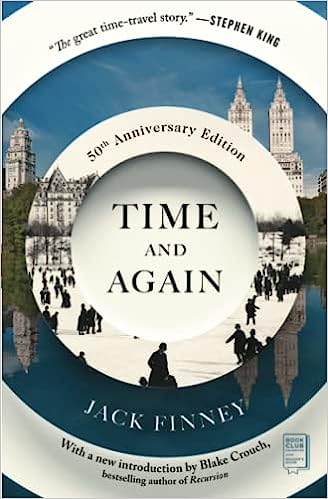
Time and Again (1970), an illustrated science fiction time travel novel by American author Jack Finney, follows Simon “Si” Morley as he is recruited to a secret government time travel project, and succeeds in traveling to 1882. There, Si tries to unravel a possible conspiracy, falls in love, and faces difficult choices between love and obligation, loyalty and ethical duty. This is the first of two novels, with the sequel From Time to Time (1995) published the year Jack Finney died. Finney left the ending open for a third novel that was never written.

Many of Jack Finney’s short stories and novels had commercial and critical success. His first novel, 5 Against the House, was published in 1954 and made into a movie in 1955. He is most famous for his second novel, The Body Snatchers (1955), which became his most commercially successful venture, spawning the 1956 movie Invasion of the Body Snatchers and its many remakes. Five of Finney’s novels and several short stories were adapted for film and television in his lifetime. However, his greatest critical success came with Time and Again, which remains his most highly-regarded work by fans and critics alike.

In the introduction to the 50th Anniversary edition of Time and Again, science fiction author Blake Crouch credits Jack Finney and this novel with starting him on the path to becoming a best-selling science fiction writer. And Stephen King, in the Afterword for his novel 11/22/63, claims it is “in this writer’s humble opinion, the great time-travel story.”

In Time and Again, the main character, Si Morley, works as an illustrator for an advertising agency in 1970s New York City, where he is dissatisfied with his life, and bored at work, with no family and a few lackluster romantic relationships. One day he receives a visitor at work, a man named “Rube” Prien–a Major in the Army, who has come to recruit Si to a top-secret government project: an experiment in time travel devised by Dr. E. E. Danziger.

Danziger, a physicist, believes he has devised a method of time travel: by tricking the brain into believing a person is already in a physical location in the past, one can become detached from their own time, and travel back in time.

Si is skeptical at first, but ultimately agrees to join the experiment if he is permitted to travel to New York in January 1882, to witness the mailing of a letter and unravel a mystery that has been haunting him and his girlfriend, Kate. Kate’s father gave her a letter once mailed to HIS father, Andrew Carmody in January 1882 – a letter that hints at a fire that may destroy the world, and was somehow connected to Carmody’s suicide years later. Si intends to learn who sent that letter and what it really means.

And so Si’s adventures in time travel begin. He travels back and forth between 1882 and the 1970s several times, uncovering a larger mystery than he could have guessed, and accidentally falling in love in the process. In his efforts to solve the mystery of the letter, he will come face to face with complex ethical questions about the limits of scientific discovery, the moral obligations of those in power, the dangers of messing with the timeline, the inevitability of fate, and what it means to find the place where you belong.

This book is widely considered a masterpiece of the time travel narrative genre. It features rich detailed descriptions of New York City in the 1880s that beautifully make the time period and setting come alive. This is aided by Finney’s meticulous use of real drawings and photographs from the time period (which he attributes to his fictitious characters), and even quotes and clippings from newspapers of the time. The characters are complex, with deep emotional resonance, genuine motivations, and rich histories. Finney treats even many of the briefly-mentioned side characters with careful attention and detail.

In addition, the narrative voice of Si Morley (the story being written in first person POV) as Morley relaying his experiences, is intelligent, wry, and humorous. Si’s sarcastic wit is often on display, both in his descriptions and in his dialogue with other characters. And his observations about humanity are thought-provoking and insightful.

Over fifty years later, Time and Again is still as impressive as it was upon its initial release. Despite a few outdated statements, it continues to be philosophically rigorous, utterly fascinating, beautifully written, and highly entertaining. I strongly believe it will remain a high benchmark for the genre for decades to come.

A Brief History of Time Travel

For a recent freelance project, I found myself revisiting some time travel narratives. Years ago I taught an entire course on time travel narratives, and it was fun to have an opportunity to dig up those old lecture notes, and re-read a couple of the novels and short stories I taught in that course. I had mentioned at the beginning of the year that I might like to re-purpose some of that work for the blog, since its become abundantly clear I’m not likely to go back into teaching any time soon and all that work might as well be put to some kind of use.

SO! I’ll be doing a handful of blog posts in a sequence about time travel. I promise not to go on about too long, but I thought it might be fun. I’ll start with a brief overview (here), and then discuss perhaps just a couple of novels and a short story or two, and end with a full reading list (and viewing list as well — since there’s some great time travel stuff in film and television). I hope that sounds like fun! It’s fun for me at least.

So without further ado: A Brief History of Time Travel

Time travel exists as a philosophical concept, a scientific principle, and narrative subgenre. The possibilities and implications of time travel have been explored for centuries and appear in many different cultures. While time travel as imagined in fiction may not be possible, some scientists argue that one-way time travel might be possible through the concept of time dilation in the special theory of relativity.

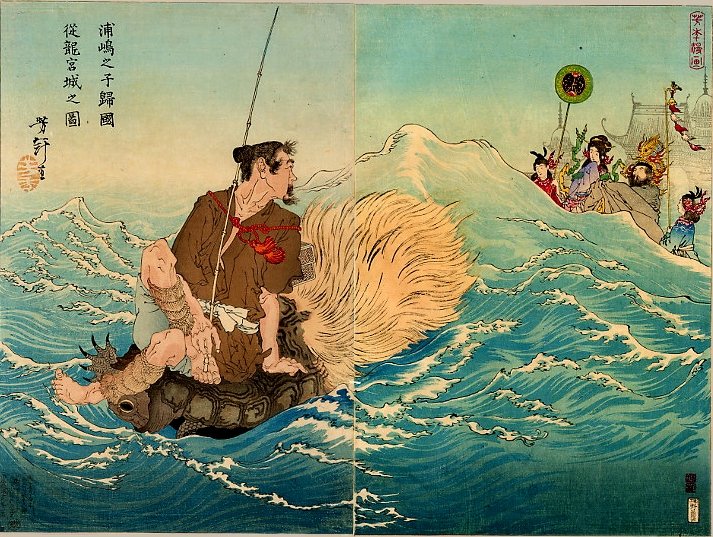
Time travel, as a narrative subgenre, exists in both fantasy and science fiction, but its earliest appearances are in myth and folklore. Two of the oldest examples are “The Tale of Kakudmi” in Hindu mythology. and “The Tale of Urashima Taro” in Japanese folklore.

“The Tale of Kakudmi” appears in several Hindu texts, most prominently the Vishnu Purana (Book IV, Ch 1) — one of 18 important ancient Hindu texts that contain stories of the Hindu gods, kings, and dynasties. When the Vishnu Purana was written is highly contested, but some estimates suppose it to be as old as 1000 BCE. “The Tale of Kakudmi,” briefly, is this:

Kakudmi was a king with a daughter named Revati. Revati was so beautiful that Kakudmi believed no one upon the Earth was worthy enough to marry her. So they went to the Hindu god Brahma to ask for advice, giving him a list of possible suitors and asking which is most worthy. However, Brahma informs them that time moves differently for the gods, and by teh time Kakudmi and Revati return from their visit with Brahma, everyone they have ever known will be long dead. In the short time Kakudmi and Revati are with Brahma, 27 catur-yugas have passed among men (1 catur-yuga = approx. 4,320,000 years according to the Vishnu Purana; so 27 catur-yugas = approx. 116,640,000 years). When Kakudmi and Revati return, they find that no only have the landscape and environment changed drastically, but that the civilizations of men have declined, becoming less than they were in Kakudmi’s own time. Kakudmi states that “he found the race of men dwindled in stature, reduced in vigour, and enfeebled in intellect,” thus making them even less worthy of his daughter than they had been in his own time.

“The Tale of Urashima Taro” is from Japanese folklore, first seen in the Nihongi, the second oldest book of classical Japanese history, and perhaps written around the 6th century. Like “The Tale of Kakudmi,” Urashima Taro is the story of a man who goes to a supernatural location, where time moves differently, so that he experiences only a handful of days while 300 years pass for normal men.

Both of these stories could be considered very early examples of the concept of time dilation, in which time moves more quickly or slowly depending on where you are, based on the theory of relativity that states all perceptions of time differ for different people in different places.

The earliest time travel in stories happened though magical or mystical means: a god, a spell, a mysterious realm. For instance, in the play Anno 7603 by Norwegian poet Johann Hermann Wessel, written in 1781, two men are sent far into the future by a good fairy, where they find that gender roles have reversed and only women are allowed to fight in the military. Then there is, of course, the case of the short story “Rip Van Winkle” by Washington Irving, published in 1918, in which a man mysteriously falls asleep and wakes up decades later without explanation.

The oldest known story of time travel by means of a machine is Edward Page Mitchell’s “The Clock That Went Backward,” written in 1881, though even this story is more magical than science-fictional. It was H. G. Wells’s famous novella The Time Machine (1895) that truly popularized the idea of time travel through scientific and mechanical means; however his short story, “The Chronic Argonauts,” includes a time machine as well, and predates the Time Machine by seven years.

The method used in the highly-regarded novel Time and Again (which will be discussed in my next post) travel is loosely inspired by Einstein’s theories of time, based on the Special Theory of Relativity, combined with the concept of “self-hypnosis.” This method was also popularized in the novel Bid Time Return by Richard Matheson (most famous for I Am Legend and What Dreams May Come), which inspired the film Somewhere in Time starring Christopher Reeve.

Since then, time travel has remained a popular trope in both fantasy and science fiction stories in both print and visual media. Many science fiction stories take great pains to offer detailed explanations for how and why time travel works. But in just as many stories, the how and why of time travel is ignored in favor of the social, historical, or personal consequences of that travel. In some cases, the time travel is merely a trope used to propel another kind of story, such as in the Outlander series (books and tv show), where the time travel elements are mostly used to allow for the romantic drama.

Literature scholar David Wittenberg argues that time travel fiction is a kind of “narratological laboratory” in which the “most basic theoretical questions about storytelling,” as well as philosophical concepts of “temporality, history, and subjectivity, are represented in the form of literal devices and plots,” for the purpose of exploration, through experiments, analysis, and criticism (Wittenberg, David. Time Travel: The Popular Philosophy of Narrative. Fordham UP, 2013).

Some of the most popular themes within time travel narratives include: fears or hopes of changing the past, alternate pasts and alternate futures, observing or communicating with another time, time loops and time paradoxes, time wars, and the prevalence of human emotions such as love overcoming the obstacles of time.

More Queer Joy Books for Pride Month!

I wanted to share some more queer stories for Pride Month, just because I can! I’ve really loved the recent explosion of queer literature. There’s always room for more improvement, and some genres get more representation than others, but overall I’m very excited to see how many more queer books we’re getting across the board: in SFF, in poetry, in literary fiction, and even in YA and children’s fiction. I’ve tried to share some recent titles in a few different genres for today.

To start with, I wanted to recommend some queer poetry! I don’t talk about poetry here much but I’m actually a HUGE poetry nerd, and read a lot of it. And quite a lot of the poetry I read is queer of some kind or another. So! I have a few to share!

Night With Exit Wounds by Ocean Vuong – this poetry collection from Vietnamese-American poet, also well known for his fiction novel On Earth We’re Briefly Gorgeous, focuses on Vuong’s experiences with immigrant parents, being an outsider in American culture, facing anti-Asian racism, and his experiences as a gay man with less-than-supportive parents, and facing homophobia in America on top of the racism he deals with. The poems are lyrical and hard-hitting. Vuong has a second poetry collection out now, Time is a Mother, which I haven’t had a chance to get my hands on yet.

Next, the two poetry collections by Chen Chen, a Chinese-American poet, examine similar issues of race, sexuality, family, and belonging. His collections are When I Grow Up I Want to Be A List of Further Possibilities, and Your Emergency Contact Has Experienced An Emergency (which I wrote a full review for here). Chen’s poetry, like Vuong’s, deals with the experiences of being an Asian immigrant in the US, and the issues of anti-Asian racism that arise from that. He is also a gay man, and examines the homophobia he experiences in American society, as well as from his parents – particularly his mother with whom he has a fraught relationship. Chen’s poetry is more visceral and blunt, with occasionally humorous or explicit language and description, and some experiments with form. His second book in particular, pulls inspiration from and pays homage to a number of other Asian-American poets, including Bhanu Kapil, Jennifer S. Cheng, Justin Chin, and Marilyn Chin.

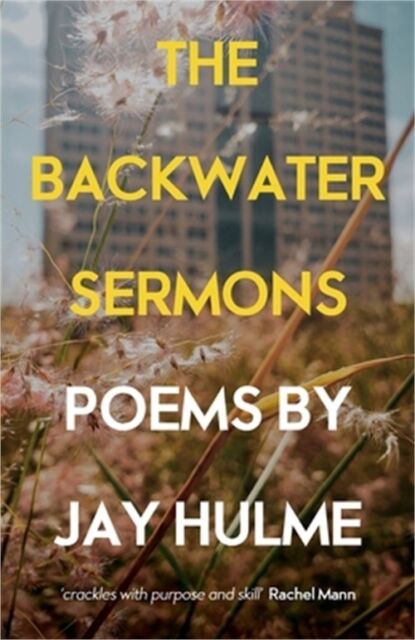
Another queer poet worth checking out is Jay Hulme, with his collection The Backwater Sermons. Jay Hulme is a trans-man in the UK, who is also a devout Christian. Much of his work deals with the complex beliefs and emotions that arise from the intersections between religion and sexuality, particularly in a christian culture where some subsections of the community are very welcoming of queer identity, and other subsections are violently and vehemently opposed. Hulme imagines gentle and accepting Jesus in a dance club, and re-frames saints with queer identities of all kinds. Personally, as a queer woman who came from a Catholic background and now has a complicated and ambivalent relationship with religion writ large, I found Hulme’s poetry and perspective on Christianity touching and enlightening and filled with a hope I have not yet found for myself. Here is one of the poems from this collection: “Jesus at the Gay Bar.”

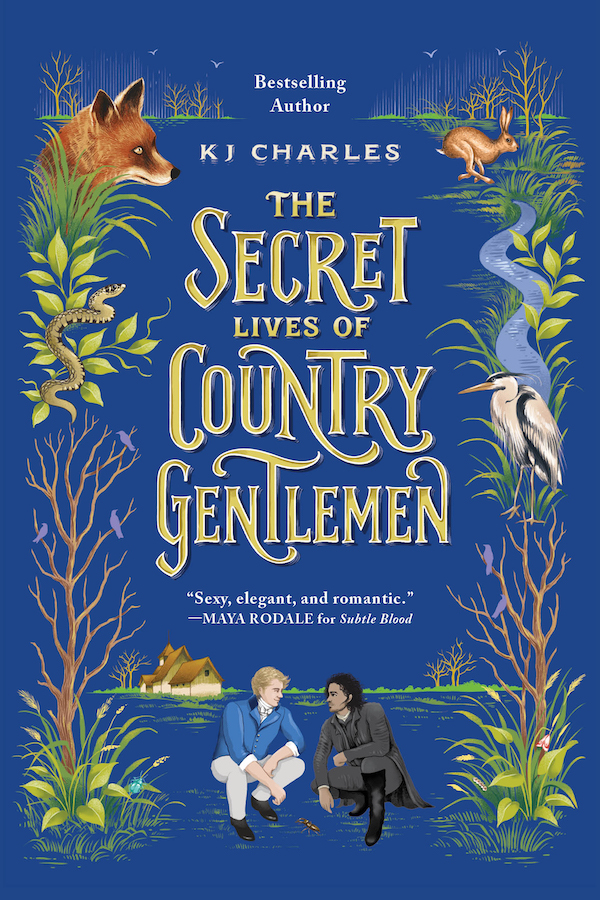
I can also highly recommend K. J. Charles’s newest release: The Secret Lives of Country Gentlemen, which is in the same vein of much of her other work. A queer historical romance, this one is set in Regency England (did I mention this is one of my favorite time periods?), and features a lonely prickly baronet, his former lover – a charming smuggler, and a creepy gothic estate on Romney Marsh. I love everything Charles writes, and this one is no exception. Hopefully, I’ll get around to writing a full review for this one eventually, but in the meantime, you should still check it out!

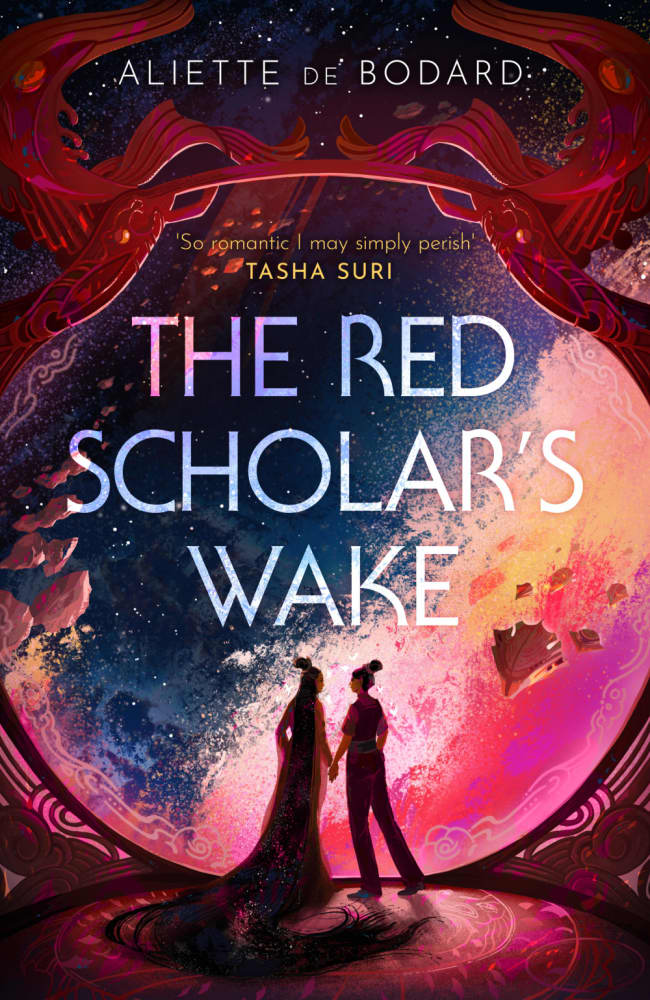
And I’ll stop, today, with The Red Scholar’s Wake by Aliette de Bodard. This one is a sapphic science fiction with space pirates, and a sentient spaceship. It’s been described as Black Sails in space, but with lesbians, romance, and Vietnamese influences. This one came out last year, and I had it on my radar then, but didn’t finally get around to buying until last week. So, I haven’t read this one yet, but it’s at the top of my TBR stack. It sounds amazing, and the reviews have been great, and I have no doubt I’ll love it when I get to it.

Some Queer Joy Books for Pride Month

I’m getting the blog back up and running, and I’m just in time, because: It’s Pride Month! In the face of all the current awfulness in the U.S. (which I’m not going to get into here, because it’s terrifying and rage-inducing and I’m tired), let’s focus on fun things. So, as your resident Disaster Bi, allow me to offer up some Queer Joy books for your reading pleasure!

By happy coincidence (probably not coincidence, they probably did it on purpose), a bunch of books releasing THIS WEEK are happy and gay!

Mortal Follies by Alexis Hall — Alexis Hall of Boyfriend Material fame, returns with a sapphic, Regency-era romance fantasy this time! Which is pretty much my absolute favorite combination of words in the English language. I’ve been a Regency-era nut since I was a kid, and when you combine sapphic, romance, and fantasy together, you put me smack-dab in my happy place. I am SO excited for this one! (I love these trope/tag meme book graphics! I don’t care if anyone else thinks they’re dumb. Also, look how pretty this cover is!)

We Could Be So Good by Cat Sebastian — the newest book from Cat Sebastian (famous for her queer books of mostly, but not only, gay man) sounds like a really great romp. You can always count on Cat Sebastian for relatable characters, engaging plots, and all the gayness. This one is set in 1950s New York, and features a scrappy newspaper writer and the son of a Newspaper Tycoon who grow close in the midst of the very dangerous anti-gay atmosphere of the 50s.

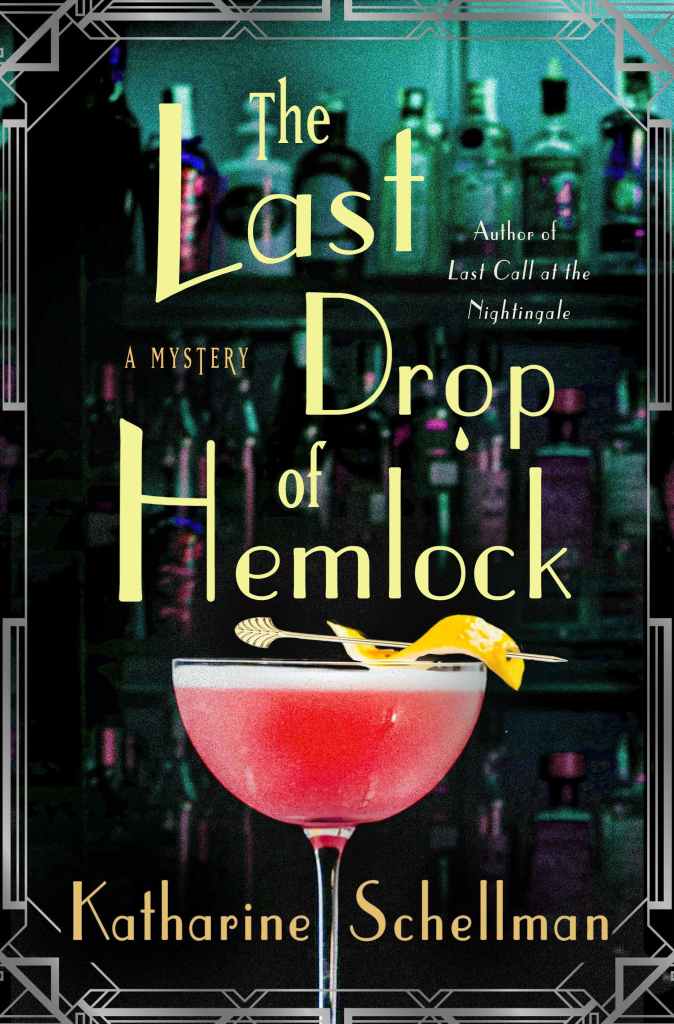
The Last Drop of Hemlock by Katherine Schellman — This book is primarily a historical mystery novel set in 1920s New York (another one of my favorite time periods!). It’s the sequel to Last Call at the Nightingale, for which I wrote a glowing review last year. Like the first, it features my fellow resident Disaster Bi, Vivian Kelly as she navigates her new job at a speakeasy, her attraction to the dangerously alluring woman who owns the speakeasy, and stumbling upon yet another murder (and, okay, this one might stretch the definition of “joy” in “Queer Joy,” as Vivian is really Going Through It, but still…). Katherine Schellman is an instant-buy for me and I cannot recommend her work highly enough! (I couldn’t find a fun graphics version of this cover, alas.)

There are, of course, PLENTY MORE. But all three of these literally released this week so I thought it would be fun to highlight them. Hopefully, I’ll do a second post with even more options. And, of course, I’ve written about plenty of queer books in the past, such as:
“Queer Romances for Pride”
“Queer Romances Redux: The Whyborne & Griffin Series”
“Book Review: Imperfect Illusions”
“Two-For-One Book Review: Marvellous Light and Restless Truth”