
I recently re-read the entirety of The Immortals Quartet by Tamora Pierce, one of the parts that makes up her massive Tortall universe. I have been a fan of Tamora Pierce’s work since I first read the Magic Circle series (ironically one of only a small number of books NOT in her Tortall series), when I was in middle school. I can’t quite remember when I first picked these up — I’m guessing probably 7th grade, so around 1997.

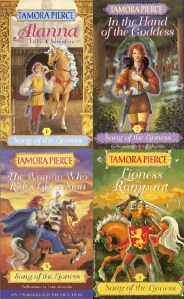
Of course, after reading and loving the Magic Circle books I went back to pick up her first quartet: Song of the Lioness, which is the first installment in the Tortall universe. And loved those as well. I have since read every single book Tamora Pierce has released. Most of them multiple times. But my favorites have always been, and remain, The Immortals Quartet, the four books that immediately followed Song of the Lioness and really first opened up the setting from that first series into the far reaching universe it is now.
The four books in this quartet consists of: Wild Magic, Wolf-Speaker, Emperor Mage, and Realm of the Gods. It features the main character Daine Sarrasri, a 13 year old girl (in the first book) who discovers that she has a special kind of magic that allows her to speak with animals and understand their thoughts and behaviors from a uniquely insider perspective. She THINKS like “The People” (what animals collectively call themselves). Daine is an orphan, her mother and grandfather murdered by raiders in her small village, and the book opens with her gaining employment with a pony trader named Onua who taking a herd of ponies from Daine’s home country of Galla, to Tortall (where most of Pierce’s books are set). The first book follows Daine as she befriends Onua, the powerful mage Numair Salmalin who becomes her friend and teacher, and a whole bevy of characters in Tortall. In this first book, we also see the emergence of magical beings called Immortals (beings like centaurs and dragons but also horrifying creatures like human-spider hybrids called spidrens and Daine’s nemesis the carrion-eating Stormwings) who, though not gods themselves, were trapped in the realm of the gods by human mages centuries ago but who have mysteriously escaped their confinement.

Throughout the series, Daine gains control of her magical ability and learns not only to speak with animals but actually shapeshift into them. She and her friends discover how the immortals escaped the realm of the gods, and befriend quite a few of the immortals, including a basilisk, a baby dragon that Daine adopts, and (much to Daine’s surprise and chagrin) even a Stormwing. The third book features Daine “losing her temper” (understatement of the decade) which remains one of my favorite parts of the entire series. In the fourth book they must wage full-out war against their enemies (both human and immortal), and Daine learns that her father was a minor hunt-god (which is how she comes by her magical ability), and she and Numair are temporarily trapped in the realm of the gods and must travel the dangerous terrain to return home.

I love these books for a lot of reasons. Whereas most of the books in the Tortall series deal with lords and kings and knights, this series brings in much more focus on the commoner. Though Daine ends up befriending the king and queen of Tortall, and several nobles and knights (including the most famous lady-knight, Alanna — main character of the Song of the Lioness), Daine herself is a commoner, as is Numair (despite his fame now as a powerful mage), and Daine brings that much needed perspective to all these “fancy folk.”
I also love getting the fascinating perspective of the animals that Daine is friends with. Pierce showcases quite a lot of research (and obviously plenty of imagination) in giving us the inner voices and lives of horses and ponies, wolves, birds, squirrels, and all sorts of other animals. The addition of all the different immortals is a ton of fun as well — I love a big menagerie of magical creatures. I think it was a really nice development as well for Daine (and most of the characters) to assign moral qualities to each species of immortal as a whole, only to then slowly learn that these immortals are just as nuanced, as much a mix of good and bad, as humans themselves are. It was a powerful lesson to learn for the characters, and a nice way to introduce that kind of nuance to the target middle-grade/YA audience (particularly back in the 90s).
Perhaps most of all though, I am a SUCKER for the romance that is laced through the last two books between Daine and Numair. I will admit that this romance would probably not fly if it was written/published today. Daine is 13 and Numair is something like 26 when they meet. They are 16 and ~29 in the fourth book. Such an age gap, when one party is under 18 years old, would send up all kinds of red flags today. And I’ll admit that even just shifting Daine two years forward, so that she’s 18 by the last book, would probably look better on paper.
That said, I believe there’s room to discuss the age issues within their own context. Pierce is writing within the context of a medieval-ish (albeit a fantasy version) world, and it is discussed within the book series that having a girl married at 14 or 15 is perfectly within the realm of possibility and reasonable expectation. We accept this in other contexts — consider, for instance, that in Pride and Prejudice, Lydia is 15 years old when she marries Wickham, which is not only legal but relatively normal at that point in history. In addition, it is made very clear that Numair himself is painfully aware of the age difference, which is why he doesn’t say anything until Daine herself presses the issue. Also: as a kid reading these books, I was also very in love with Numair Salmalin, so I was hardly going to fault Daine for being too young for him. And the way the relationship develops between them over the course of the books, especially the last two, is just so sweet and cute that you can’t help but be enchanted (well, I can’t help it at any rate).
It had been quite a while since the last time I had re-read these books. But I’m finding myself in a major re-reading mood lately — I think because between work-stress and general-state-of-the-world stress, my anxiety has been at record highs and re-reading comfort books is just safer right now. I read each book in about a day, so the whole quartet in less than a week. And I gotta say, I love them just as much now at the age of 36 (nearly 37 – my birthday is in 2 weeks, fun fact!), as I did when I was 12. Some books never lose their enchantment and joy, no matter how old you get, or how many times you read them. This series is clearly one of them, for me at least.




 Amanda Haimoto Rudd